Minecraft OptiFine 1.21.1: Complete Guide to FPS Boost, Shaders, Installation and Performance Optimization (2026)
Minecraft can push even powerful computers when worlds grow larger and builds become more complex. Low FPS, stuttering, and long chunk loading can ruin the experience. Minecraft OptiFine 1.21.1 solves these problems while making the game look better. It improves performance, unlocks advanced graphics settings, and adds support for popular shader packs and HD resource packs. Minecraft OptiFine 1.21.1 is a free optimization mod for Minecraft Java Edition 1.21.1. It boosts FPS, improves graphics, adds advanced video settings, and supports shaders, HD textures, and custom visual features. It helps players enjoy smoother gameplay without changing Minecraft’s core mechanics.
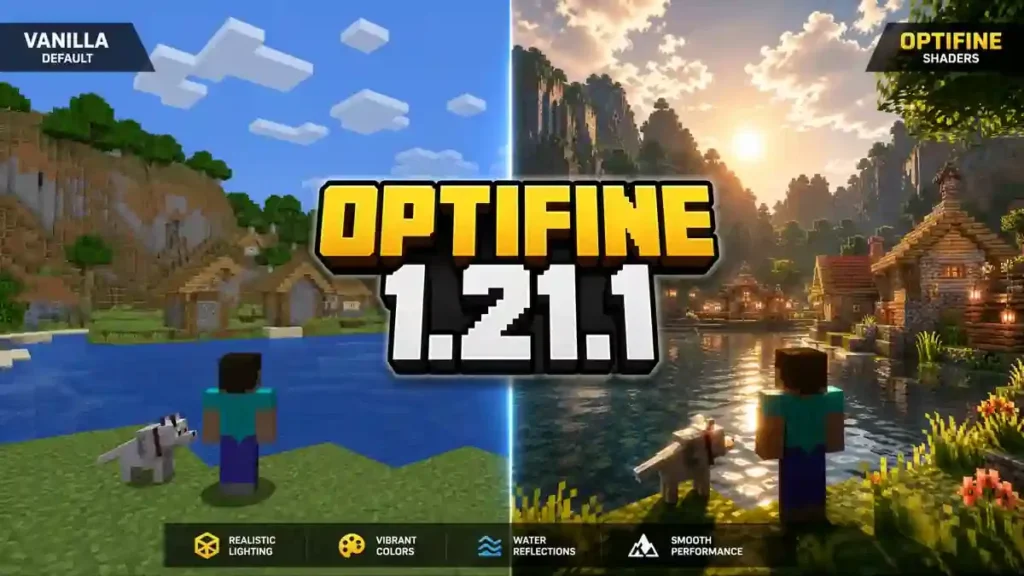
Millions of players continue to use OptiFine 1.21.1 because it balances performance and visual quality. Beginners can install it in minutes and enjoy smoother gameplay. Experienced players can fine-tune graphics, optimize rendering, and customize nearly every visual setting. Whether you play survival, creative, multiplayer, or large modded worlds, OptiFine offers tools that improve the experience. One of its biggest strengths is performance optimization. OptiFine reduces lag, speeds up chunk loading, and improves frame rates on many systems. It also includes advanced settings such as Render Regions, Smart Animations, Dynamic Lighting, Fast Math, and Smooth FPS. These features help both low-end laptops and high-end gaming PCs run Minecraft more efficiently.
OptiFine also transforms Minecraft’s visuals. It supports realistic shader packs, high-resolution HD texture packs, connected textures, custom skies, emissive textures, better grass, better snow, and many other graphical enhancements. These features let you create a world that looks far more detailed while keeping performance under control. Another advantage is broad launcher compatibility. You can install Minecraft OptiFine 1.21.1 with the official Minecraft Launcher and popular launchers such as Prism Launcher, MultiMC, CurseForge, Modrinth App, and ATLauncher. It also works alongside many Forge-based setups when compatible versions are available.
This guide explains everything you need to know about OptiFine 1.21.1. You will learn how to download and install it safely, choose the best FPS settings, use shaders and resource packs, fix common errors, compare it with alternatives like Sodium, and get the best performance from your Minecraft world.
What is Minecraft OptiFine 1.21.1?
Minecraft OptiFine 1.21.1 is a performance and graphics optimization mod for Minecraft Java Edition 1.21.1. It improves frame rates, adds advanced video settings, enhances visual quality, and supports shaders and HD resource packs. Unlike content mods, OptiFine does not add new blocks, mobs, or gameplay mechanics. Instead, it focuses on making Minecraft run smoother and look better. OptiFine has been one of the most trusted Minecraft optimization projects for over a decade. It has evolved alongside Minecraft through many major updates. Each release adapts to changes in the game’s rendering system while introducing new performance improvements and graphical features. Because of its long history and active development, millions of players rely on OptiFine for everyday gameplay.
The mod is developed by sp614x, a well-known developer in the Minecraft community. Since its first release, OptiFine has become the standard choice for players who want higher FPS and better graphics without changing Minecraft’s core experience. Its consistent updates and wide feature set have helped it remain one of the most downloaded Minecraft mods.
Why Does OptiFine Exist?
Minecraft generates large worlds in real time. Every chunk, block, entity, particle, and lighting effect requires processing power. As worlds become larger, the game demands more from your CPU and GPU. This can lead to low FPS, lag spikes, stuttering, and slow chunk loading. OptiFine addresses these challenges by improving how Minecraft renders and processes game data. Instead of forcing your computer to perform unnecessary work, it optimizes many background tasks. This allows the game to use system resources more efficiently while maintaining visual quality. The result is smoother gameplay, faster world loading, and a more responsive experience across many types of hardware.
How OptiFine Improves Minecraft Java Edition
OptiFine enhances several core systems without changing Minecraft’s gameplay. Its improvements focus on performance, rendering, graphics, and customization. Performance optimization reduces unnecessary rendering work and improves chunk management. Many players notice higher FPS, smoother movement, and fewer frame drops after installation. The exact improvement depends on your hardware, graphics settings, installed mods, and world complexity.
Rendering improvements help Minecraft display chunks, lighting, and animations more efficiently. Features such as Render Regions, Smart Animations, Fast Render, and Dynamic Updates reduce graphical overhead while keeping the game responsive. OptiFine also expands Minecraft’s video settings. The standard game offers basic graphics controls. OptiFine unlocks dozens of additional options that let players fine-tune performance and image quality. You can adjust render distance, animation effects, lighting quality, mipmaps, fog, particles, connected textures, entity distance, and many other settings to match your system.
Vanilla Minecraft vs. OptiFine
Vanilla Minecraft provides a simple graphics menu and limited performance controls. It works well for many players, but it offers fewer ways to optimize the game for different hardware. OptiFine builds on the vanilla experience by adding advanced customization without changing Minecraft’s core mechanics. You still play the same game, but you gain much greater control over how it performs and looks.
With OptiFine, you can enable Dynamic Lighting, use shader packs, install HD resource packs, activate Connected Textures (CTM), add Custom Entity Models (CEM), and improve visual effects that vanilla Minecraft does not support. These enhancements allow players to create anything from a lightweight FPS-focused setup to a highly realistic world.
How OptiFine Works
OptiFine works by optimizing Minecraft’s rendering pipeline and graphics engine. It adjusts how chunks load, how textures render, how lighting updates, and how visual effects display on screen. It also introduces smarter rendering techniques that reduce unnecessary calculations and improve resource management. The mod gives players direct control over graphics features that normally remain fixed. This flexibility allows you to balance visual quality and performance based on your hardware. A low-end laptop can prioritize FPS, while a high-end gaming PC can enable advanced shaders and high-resolution textures without sacrificing stability.
By combining performance optimization, rendering improvements, advanced video settings, and graphics engine enhancements, Minecraft OptiFine 1.21.1 delivers a smoother, more customizable Minecraft experience while preserving the gameplay players already know and enjoy.
What’s New in OptiFine 1.21.1?
OptiFine 1.21.1 continues the mod’s long tradition of improving Minecraft Java Edition performance and graphics customization. This release focuses on better compatibility with Minecraft 1.21.1, smoother rendering, improved visual features, and internal optimizations that create a more stable gameplay experience. The latest OptiFine HD U release for Minecraft 1.21.1 brings updated support for the game’s newer rendering changes. Minecraft updates often modify internal systems, textures, resource handling, and graphics processes. OptiFine adapts these changes to maintain compatibility while preserving its popular optimization features.
Improved Performance and FPS Optimization
One of the main goals of OptiFine 1.21.1 is better performance. The update improves how Minecraft handles rendering tasks, chunk updates, animations, and graphical effects. These improvements help reduce unnecessary processing and create smoother gameplay. Players with older computers can benefit from optimized settings that reduce lag and improve frame stability. Users with powerful gaming systems can also take advantage of advanced graphics options without losing performance.
OptiFine continues to improve features such as:
- FPS Boost settings
- Smooth FPS
- Smooth World
- Fast Render options
- Chunk loading controls
- Animation management
- Render optimization
These tools allow players to customize Minecraft based on their hardware.
Rendering Improvements
OptiFine 1.21.1 improves Minecraft’s rendering process by optimizing how the game displays blocks, entities, lighting effects, and textures. Better rendering efficiency helps reduce visual stuttering and improves overall responsiveness.
The update also improves compatibility with modern graphical features, including:
- Shader rendering
- HD textures
- Connected textures
- Custom visual effects
- Advanced lighting options
These improvements allow players to create detailed Minecraft environments while maintaining smoother performance.
Better Compatibility With Minecraft Features
Minecraft 1.21.1 introduced new changes to the game engine and resource systems. OptiFine 1.21.1 adjusts its features to work better with these updates.
The release improves compatibility with:
- Minecraft Java Edition 1.21.1
- Modern resource packs
- Shader packs
- Custom textures
- Advanced graphics settings
- Popular Minecraft launchers
This helps players install OptiFine into their existing setups with fewer conflicts.
Bug Fixes and Stability Improvements
Every OptiFine update includes fixes that improve reliability. OptiFine 1.21.1 addresses issues related to rendering, textures, shaders, and graphics settings.
These fixes help prevent problems such as:
- Visual glitches
- Shader loading errors
- Texture display problems
- Graphics crashes
- Incorrect rendering behavior
A more stable experience means fewer interruptions during gameplay.
Updated Shader and Resource Pack Support
Shader support remains one of OptiFine’s biggest advantages. The 1.21.1 release continues improving compatibility with modern shader packs that transform Minecraft’s lighting, shadows, water effects, and atmosphere. OptiFine 1.21.1 also improves support for high-resolution resource packs. Players can use detailed textures, connected textures, custom models, and enhanced visual effects more effectively.
Internal Optimizations
Beyond visible features, OptiFine 1.21.1 includes internal improvements that help Minecraft run more efficiently. These changes optimize how the mod communicates with Minecraft’s rendering engine and manages graphical resources. The result is a smoother experience with better stability, improved customization, and stronger support for modern Minecraft graphics. Overall, Minecraft OptiFine 1.21.1 focuses on refinement rather than unnecessary changes. It improves performance, expands visual possibilities, and keeps one of Minecraft’s most popular optimization mods compatible with Minecraft 1.21 and 1.21.1 (OptiFine HD U J1).
Main Features Explained
Minecraft OptiFine 1.21.1 offers a wide range of performance and graphics features that improve how Minecraft Java Edition looks and runs. These tools give players more control over rendering, textures, lighting, animations, and overall game performance. Unlike standard Minecraft settings, OptiFine unlocks advanced options that help players balance visual quality and FPS. You can create a lightweight setup for a low-end PC or a highly detailed experience with shaders and HD textures and Does OptiFine Make Minecraft Run Better.
FPS Boost
FPS Boost is one of the main reasons players install OptiFine 1.21.1. It improves Minecraft performance by optimizing rendering processes and reducing unnecessary workload on your hardware. OptiFine adjusts how Minecraft handles chunks, animations, particles, and graphics effects. These changes can increase frame rates, reduce stuttering, and create smoother gameplay.
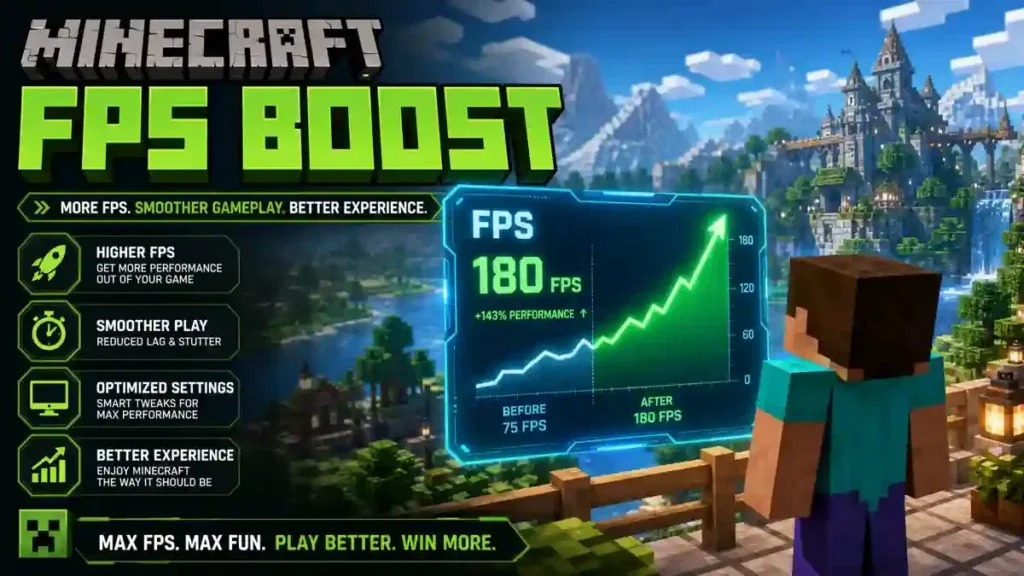
The FPS improvement depends on your system specifications. Older laptops often see noticeable improvements, while high-end PCs gain better frame stability during demanding situations.
Important FPS optimization features include:
- Smooth FPS
- Fast Render
- Fast Math
- Render Regions
- Smart Animations
- Performance settings
- Advanced video controls
These options allow players to customize Minecraft based on their hardware.
Dynamic Lighting
Dynamic Lighting adds realistic light effects to Minecraft. It allows handheld light sources, such as torches and glow items, to illuminate the surrounding area without placing them on blocks. In vanilla Minecraft, a torch only creates light after placement. OptiFine changes this behavior by allowing items in your hand or dropped items to produce light.
This feature improves exploration in:
- Caves
- Mines
- Dark structures
- Underground areas
Dynamic Lighting creates a more immersive experience while maintaining Minecraft’s original gameplay style.
Connected Textures (CTM)
Connected Textures, also called CTM, improves the appearance of blocks by connecting matching textures together. Without CTM, many Minecraft blocks display separate textures with visible borders. OptiFine combines these textures to create smoother patterns.
Examples include:
- Connected glass
- Improved bookshelf designs
- Better stone patterns
- Enhanced building materials
CTM works with compatible resource packs and helps builders create more detailed structures.
HD Texture Support
OptiFine 1.21.1 supports high-resolution resource packs that improve Minecraft’s visual quality. Vanilla Minecraft limits some texture options. OptiFine removes many restrictions and allows players to use detailed packs with resolutions such as:
- 32x
- 64x
- 128x
- 256x
- Higher resolutions
HD texture support improves blocks, items, environments, and character details. Players can create realistic or highly customized worlds without changing gameplay mechanics.
Shader Support
Shader support is one of OptiFine’s most popular features. It allows Minecraft players to use shader packs that completely transform lighting and visual effects.
Shaders can add:
- Realistic shadows
- Better water reflections
- Dynamic lighting
- Improved skies
- Atmospheric effects
- Enhanced colors
Popular shader packs include BSL Shaders, Complementary Shaders, SEUS, Sildur’s Vibrant Shaders, and Chocapic13. Shader performance depends on your GPU and selected settings. Players with weaker hardware can use lightweight shaders, while powerful PCs can enable realistic graphics.
Smart Animations
Smart Animations improves performance by reducing unnecessary animation rendering. Minecraft often processes animations that are not visible to the player. OptiFine detects unused animations and reduces their impact on performance.
This feature helps improve FPS, especially when using:
- Large resource packs
- Animated textures
- Complex worlds
Smart Animations provides better performance without removing visible effects.
Better Grass
Better Grass improves the appearance of grass blocks by extending grass textures to the sides of blocks. In vanilla Minecraft, grass blocks have green tops but plain dirt-colored sides. OptiFine creates a more natural look by adding connected grass textures. This feature works with compatible resource packs and improves terrain visuals.
Better Snow
Better Snow enhances snowy environments by creating more realistic snow coverage. Instead of showing only basic snow layers, OptiFine can apply snow textures to nearby blocks for a smoother winter appearance.
This feature improves:
- Snowy mountains
- Frozen biomes
- Winter-themed builds
Natural Textures
Natural Textures removes repetitive patterns from blocks by rotating and changing similar textures automatically. For example, wooden blocks or stone textures can appear more varied instead of repeating the same pattern. This creates more natural-looking environments without requiring additional mods.
Custom Colors
Custom Colors allows resource packs to change Minecraft’s default color settings.
It improves customization for:
- Biomes
- Lighting
- Textures
- Environmental effects
Resource packs can create unique color themes and visual styles using this feature.
Custom Sky
Custom Sky replaces Minecraft’s default sky with custom designs from compatible resource packs.
It can add:
- Different sky colors
- Realistic sunsets
- Space effects
- Fantasy environments
This feature works especially well with shader packs and detailed resource packs.
Emissive Textures
Emissive Textures allow specific textures to glow in dark areas.
Examples include:
- Glowing ores
- Bright eyes
- Illuminated blocks
- Special items
This feature improves visibility and adds extra detail to custom resource packs.
Random Entities
Random Entities changes the appearance of mobs using different textures. For example, animals can have multiple skin variations instead of identical appearances. This creates more natural environments and improves visual variety.
Render Regions
Render Regions improve chunk rendering efficiency. This feature helps Minecraft manage large areas more effectively by organizing chunks into optimized sections. Players may experience smoother movement and better performance when exploring large worlds.
Fast Render
Fast Render improves Minecraft’s rendering speed by optimizing certain graphical operations. It can increase FPS on supported systems. However, some shader features may require disabling Fast Render because of compatibility limitations.
Fast Math
Fast Math improves mathematical calculations used by Minecraft’s rendering system. It reduces processing time for certain calculations and can provide small performance improvements.This feature works best as part of a complete FPS optimization setupLazy Chunk LoadingLazy Chunk Loading controls how Minecraft loads world chunks. Instead of processing everything immediately, it manages chunk loading more efficiently. This can reduce lag spikes and improve world exploration performance.
Anti-Aliasing
Anti-Aliasing smooths rough edges on blocks and objects. Without anti-aliasing, diagonal lines can appear jagged. This feature creates cleaner visuals by smoothing edges. Higher settings improve quality but may reduce FPS.
Anisotropic Filtering
Anisotropic Filtering improves texture clarity when viewing surfaces from different angles.
It makes distant textures appear sharper, especially:
- Roads
- Floors
- Landscapes
- Long structures
This feature improves image quality with a small performance impact on modern GPUs.
Zoom Feature
The Zoom Feature allows players to magnify distant objects.
It works similarly to a camera zoom and helps players see:
- Distant locations
- Hidden structures
- Other players
- Terrain details
Many Minecraft players use it for exploration and multiplayer gameplay.
Advanced Video Settings
OptiFine expands Minecraft’s basic graphics menu with detailed controls.
Players can adjust:
- Performance options
- Quality settings
- Animations
- Details
- Lighting
- Rendering distance
These settings provide complete control over Minecraft’s appearance and performance.
Mipmap Levels
Mipmap Levels improve texture quality at different distances. Higher mipmap levels create smoother distant textures. Lower levels can improve FPS on weaker systems. Players can adjust this setting based on their hardware.
Fog Control
Fog Control allows players to customize Minecraft’s fog effects. You can adjust or disable fog to improve visibility and performance. This helps players who prefer clearer views during exploration.
Chunk Loading Controls
Chunk Loading Controls manage how Minecraft loads and updates terrain.
Players can adjust these settings to balance:
- Loading speed
- View distance
- Performance
Proper configuration reduces stuttering during exploration.
Entity Distance
Entity Distance controls how far Minecraft renders mobs and objects. Lower settings improve FPS by reducing the number of visible entities. Higher settings provide better visibility but require more system resources.
Animation Controls
Animation Controls allow players to enable or disable specific animations.
You can control effects such as:
- Water animation
- Lava animation
- Fire animation
- Portal effects
- Redstone animations
Disabling unnecessary animations can improve FPS.
Weather Settings
Weather Settings provide control over Minecraft weather effects.
Players can adjust or disable:
- Rain
- Snow
- Weather particles
Reducing weather effects can improve performance during storms.
Performance Settings
Performance Settings contain OptiFine’s main optimization tools.
They include options such as:
- Smooth FPS
- Smooth World
- Fast Render
- Fast Math
- Chunk updates
- Smart Animations
These settings help players achieve better frame rates and smoother gameplay.
Quality Settings
Quality Settings control Minecraft’s visual improvements.
They include:
- Connected Textures
- Custom Colors
- Better Grass
- Better Snow
- Natural Textures
- Mipmap settings
Players can increase visual quality or reduce settings for better performance. Together, these features make Minecraft OptiFine 1.21.1 one of the most customizable optimization solutions for Minecraft Java Edition. It gives players control over performance, graphics, and visual customization while keeping the original Minecraft experience intact.
System Requirements for Minecraft OptiFine 1.21.1
Before installing Minecraft OptiFine 1.21.1, check that your computer can run Minecraft Java Edition smoothly. OptiFine improves performance, but your hardware still affects FPS, shader performance, and overall gameplay quality.
Minimum Requirements
OptiFine 1.21.1 does not require a powerful computer. A basic system can run Minecraft with performance-focused settings.
Minimum system recommendations:
- Operating System: Windows 10/11, macOS, or Linux
- CPU: Intel Core i3 or AMD equivalent
- RAM: 4GB minimum
- GPU: Intel HD Graphics, AMD Radeon, or NVIDIA graphics with OpenGL support
- Storage: At least 2GB free space
- Java: 64-bit Java Runtime Environment
These specifications can handle Minecraft with lower graphics settings and basic OptiFine optimization features.
Recommended Requirements
For smoother gameplay, higher render distance, shaders, and HD resource packs, a stronger system provides better results.
Recommended specifications:
- CPU: Intel Core i5/i7 or AMD Ryzen 5/7
- RAM: 8GB or more
- GPU: NVIDIA GTX series, RTX series, AMD Radeon RX series, or equivalent
- Storage: SSD recommended
- Java: Latest 64-bit Java version
A recommended setup allows players to use advanced features such as shaders, high-resolution textures, and increased render distance.
Java Requirements
OptiFine 1.21.1 requires Java to run the installer and Minecraft Java Edition.
Minecraft 1.21.1 uses modern Java versions. Players should install a compatible 64-bit Java Runtime Environment. A 64-bit version allows Minecraft to access more memory and improves stability.
Using outdated Java versions can cause problems such as:
- Installer not opening
- Java errors
- Minecraft crashes
- Performance issues
Always use a trusted Java distribution and keep it updated.
RAM Requirements
RAM affects world loading, mod compatibility, and overall stability.
- 4GB RAM: Suitable for basic Minecraft gameplay
- 8GB RAM: Recommended for most players
- 16GB RAM: Ideal for shaders, large modpacks, and HD textures
Avoid allocating too much RAM. Minecraft also needs memory for your operating system and background applications.
GPU Requirements
Your graphics card controls Minecraft’s visual performance.
OptiFine works with:
- NVIDIA GPUs
- AMD Radeon GPUs
- Intel integrated graphics
Shader packs require stronger GPUs because they add advanced lighting, shadows, reflections, and atmospheric effects.
CPU Requirements
Minecraft depends heavily on CPU performance, especially for:
- Chunk loading
- World generation
- Entity processing
- Simulation distance
A modern multi-core processor provides smoother gameplay.
Supported Operating Systems
Windows
Windows provides the widest compatibility for OptiFine 1.21.1. Most players use Windows 10 or Windows 11 with the official Minecraft Launcher.
macOS
OptiFine supports Minecraft Java Edition on macOS. Players need compatible Java installation and proper graphics drivers.
Linux
Linux users can install OptiFine through Java and use launchers such as Prism Launcher or MultiMC. Performance depends on hardware and graphics driver support.
How to Download OptiFine 1.21.1 Safely
Downloading OptiFine 1.21.1 from a trusted source is important. Many unofficial websites distribute modified files that may contain unwanted software. Always verify the download source before running any installer.
Official Download Process
The safest method is downloading OptiFine from the official OptiFine website. The official page provides original releases, preview builds, and version-specific installers.
The download process usually includes:
- Visit the official OptiFine download page.
- Select the Minecraft 1.21.1 version.
- Choose the available OptiFine release.
- Download the
.jarinstaller file. - Save the file to your computer.
- Run the installer using Java.
The official installer automatically detects your Minecraft directory and creates the required OptiFine profile.
OptiFine Installer
The OptiFine installer comes as a Java .jar file. It does not work like a normal Windows program.
Before opening the installer:
- Install 64-bit Java.
- Confirm Minecraft 1.21.1 exists in your launcher.
- Close Minecraft before installation.
After launching the installer, click Install. OptiFine will create a new Minecraft profile that appears in the official launcher.
Mirror Downloads
Some users access OptiFine through mirror download links. Mirrors can provide faster downloads when the main server experiences heavy traffic. However, always confirm that the mirror redirects to the original OptiFine file. Avoid websites that modify the installer or bundle additional programs.
Preview Versions
OptiFine sometimes releases preview versions before stable builds.
Preview versions may include:
- Early feature support
- Experimental fixes
- Compatibility improvements
However, they may also contain bugs. Most players should choose stable releases for daily gameplay.
Stable Versions
Stable OptiFine releases provide better reliability. They receive more testing and work better for regular Minecraft survival, multiplayer, and creative gameplay.
Choose stable versions when you want:
- Fewer crashes
- Better shader compatibility
- Reliable performance
Security Tips Before Installation
Follow these safety steps:
- Download only from trusted sources.
- Avoid installers in
.exeformat from unknown websites. - Scan files with security software.
- Check the file extension before opening.
- Keep Java updated.
- Avoid websites offering “OptiFine with extra features.”
A genuine OptiFine installer is normally a Java .jar file.
Fake Websites to Avoid
Many websites use names similar to OptiFine and rank for download searches. These sites may show misleading buttons, advertisements, or modified files.
Avoid websites that:
- Bundle unknown software
- Require suspicious installers
- Offer cracked versions
- Ask for unnecessary permissions
- Change the OptiFine file name
Always verify that you download the original release.
File Verification
Before installing OptiFine 1.21.1, verify the downloaded file.
Check:
- File name
- File extension
- File size
- Source website
- Security scan results
You can also compare file information with trusted community references. A safe download ensures that Minecraft OptiFine 1.21.1 works correctly and protects your system from unwanted software. A verified installer gives you access to FPS optimization, shaders, HD textures, and advanced graphics settings without security risks.
How to Install OptiFine 1.21.1
Installing Minecraft OptiFine 1.21.1 is a simple process when you follow the correct steps. The installation requires Java, the OptiFine installer, and a working Minecraft Java Edition 1.21.1 installation. OptiFine uses a Java-based installer, so your computer must have a compatible 64-bit Java version before starting. After installation, the Minecraft Launcher creates a dedicated OptiFine profile that lets you launch the optimized version of Minecraft.
Install OptiFine 1.21.1 on Windows
Step 1: Install Java
Before running the OptiFine installer, install the latest compatible 64-bit Java Runtime Environment.
Follow these steps:
- Download Java from a trusted source.
- Install the 64-bit version.
- Restart your computer if required.
- Confirm Java works correctly.
Java allows your system to open the OptiFine .jar installer file.
Common Java problems include:
- OptiFine installer does not open
- Windows asks which program should open the file
- Java runtime errors appear
If these problems occur, reinstall Java and try again.
Step 2: Download the OptiFine 1.21.1 Installer
Download the correct OptiFine 1.21.1 release file.
The installer should have a .jar extension.
Example:
OptiFine_1.21.1_HD_U_*.jar
Avoid renamed files or unknown installers from third-party websites.
Step 3: Run the Installer
After downloading the file:
- Locate the OptiFine
.jarfile. - Double-click the installer.
- Wait for the OptiFine installation window.
- Confirm the Minecraft folder location.
- Click Install.
The installer automatically detects your Minecraft directory in most cases. [Screenshot Placeholder: OptiFine installer window showing the Install button] After successful installation, you will see a confirmation message.
Step 4: Open Minecraft Launcher
Launch the official Minecraft Launcher.
Follow these steps:
- Open Minecraft Launcher.
- Go to the Installations tab.
- Find the new OptiFine profile.
- Select the OptiFine installation.
- Click Play.
The launcher now starts Minecraft with OptiFine 1.21.1 enabled. [Screenshot Placeholder: Minecraft Launcher showing OptiFine profile]
Step 5: First Launch
The first OptiFine launch may take longer than normal. Minecraft needs to load new files and create optimized settings.
After entering the game:
- Open Options.
- Select Video Settings.
- Confirm OptiFine options appear.
- Adjust settings based on your hardware.
You should now see additional features such as:
- Shaders
- Dynamic Lighting
- Advanced Video Settings
- Performance Controls
- Quality Settings
Install OptiFine 1.21.1 on macOS
The installation process on macOS works similarly to Windows.
Step 1: Install Java
Install a compatible 64-bit Java version.
After installation:
- Open Terminal.
- Check Java installation.
- Confirm your system recognizes Java.
Java allows macOS to execute the OptiFine installer.
Step 2: Download OptiFine Installer
Download the OptiFine 1.21.1 .jar installer. Save the file in an easy-to-find location, such as Downloads.
Step 3: Open the Installer
macOS may block unknown Java applications.
If the installer does not open:
- Open System Settings.
- Go to Privacy & Security.
- Allow the Java application.
- Run the installer again.
Select the Minecraft folder and click Install. [Screenshot Placeholder: macOS OptiFine installation window]
Step 4: Launch Minecraft
Open Minecraft Launcher.
Then:
- Select the OptiFine profile.
- Click Play.
- Wait for the first launch.
- Open Video Settings to confirm installation.
OptiFine should now run correctly on Minecraft Java Edition 1.21.1.
Install OptiFine 1.21.1 on Linux
Linux users can install OptiFine through Java and their preferred Minecraft launcher.
Step 1: Install Java
Install a compatible Java package using your Linux distribution.
Examples:
- Ubuntu
- Fedora
- Arch Linux
After installation, verify Java works correctly.
Step 2: Download OptiFine
Download the OptiFine 1.21.1 .jar installer. Move the file to your preferred folder.
Step 3: Run the Installer
Open Terminal and navigate to the download location. Run the installer through Java. The installation window will appear. Select the Minecraft directory and click Install.
Step 4: Launch Minecraft
Open your Minecraft Launcher. Select the OptiFine profile. Start Minecraft Optifine and check the Video Settings menu. Linux users often combine OptiFine with launchers such as Prism Launcher or MultiMC for easier profile management.
Creating the OptiFine 1.21.1 Profile
After installation, Minecraft Launcher creates a separate OptiFine profile.
This profile contains:
- Minecraft version
- OptiFine settings
- Game directory information
- Java configuration
To manage it:
- Open Minecraft Launcher.
- Select Installations.
- Choose OptiFine.
- Edit settings if needed.
- Click Play.
You can keep your vanilla Minecraft profile and switch between versions anytime.
Install OptiFine with Forge
OptiFine 1.21.1 with Forge allows players to combine graphics optimization with Minecraft mods. However, compatibility depends on the exact Forge version and OptiFine release. Forge is a popular mod loader that allows Minecraft players to install additional gameplay modifications. OptiFine focuses on graphics and performance improvements.
Compatibility
Before installing, check:
- Minecraft version matches 1.21.1
- Forge version supports OptiFine
- Installed mods do not conflict
- Java version is compatible
Not every Forge mod works perfectly with OptiFine. Some rendering-related mods may cause crashes.
Correct Installation Order
Follow this order:
1. Install Minecraft 1.21.1
Launch vanilla Minecraft once before adding mods.
2. Install Forge
Download and install the correct Forge version for Minecraft 1.21.1. Open Minecraft Launcher and confirm Forge appears.
3. Install OptiFine
Place the OptiFine file inside the Minecraft mods folder if the version supports this method. Alternatively, follow the installation instructions provided for the specific OptiFine and Forge combination.
4. Launch Forge Profile
Open Minecraft using the Forge profile. Check the Mods menu and Video Settings to confirm installation.
Limitations of OptiFine With Forge
OptiFine compatibility with Forge can vary.
Possible limitations include:
- Mod conflicts
- Shader issues
- Rendering problems
- Reduced compatibility with newer mods
- Crashes caused by conflicting graphics changes
Always test OptiFine with a small number of mods first.
Common Forge and OptiFine Issues
Minecraft Crashes on Launch
Possible causes:
- Incompatible mods
- Wrong Forge version
- Java problems
Solution:
- Remove conflicting mods.
- Check version compatibility.
- Update Java.
Shaders Do Not Work
Some Forge setups can affect shader loading.
Solution:
- Check shader compatibility.
- Update OptiFine.
- Remove conflicting rendering mods.
Missing OptiFine Features
Some mod combinations may disable certain OptiFine features.
Solution:
- Test OptiFine without other mods.
- Add mods one by one.
Installing OptiFine 1.21.1 correctly ensures access to FPS improvements, shader support, HD textures, and advanced graphics settings while keeping Minecraft Java Edition stable.
Install OptiFine 1.21.1 on Popular Launchers
Minecraft OptiFine 1.21.1 works with several popular Minecraft launchers. Each launcher handles game files and profiles differently, but the main goal remains the same: create a Minecraft installation that launches with OptiFine enabled.
Before installation, make sure you have:
- Minecraft Java Edition 1.21.1 installed
- Compatible Java version
- OptiFine 1.21.1 installer
- A working launcher profile
Minecraft Launcher
The official Minecraft Launcher provides the simplest OptiFine installation method.
Steps:
- Install OptiFine 1.21.1 using the
.jarinstaller. - Open Minecraft Launcher.
- Go to the Installations tab.
- Find the OptiFine profile.
- Select the profile and click Play.
The launcher automatically detects the installed OptiFine version and creates a separate profile. You can keep your vanilla Minecraft profile and switch between versions anytime.
Prism Launcher
Prism Launcher is popular among modded Minecraft players because it offers advanced instance management.
Steps:
- Open Prism Launcher.
- Create a new Minecraft 1.21.1 instance.
- Select the correct Minecraft version.
- Install OptiFine through the instance settings.
- Add the required OptiFine files.
- Launch the instance.
Prism Launcher allows you to create separate profiles for:
- Vanilla Minecraft
- OptiFine
- Modded setups
- Different Java versions
This makes testing different configurations easier.
MultiMC
MultiMC provides a lightweight way to manage multiple Minecraft installations.
Steps:
- Create a new Minecraft 1.21.1 instance.
- Open the instance settings.
- Add OptiFine as a component or required file.
- Configure Java settings.
- Launch Minecraft.
MultiMC is useful for players who maintain several Minecraft versions. You can create separate OptiFine profiles without affecting your main game installation.
CurseForge Launcher
CurseForge focuses mainly on Minecraft modpacks, but it can also manage custom installations.
Steps:
- Open CurseForge.
- Create or select a Minecraft profile.
- Choose Minecraft version 1.21.1.
- Add OptiFine if the profile supports it.
- Launch the game.
Keep in mind that some modpacks use alternative optimization mods. Check compatibility before adding OptiFine.
Modrinth App
The Modrinth App provides a modern way to manage Minecraft instances and mods.
Steps:
- Create a Minecraft 1.21.1 instance.
- Select the required loader or vanilla profile.
- Add OptiFine if supported.
- Configure Java settings.
- Start Minecraft.
Modrinth users often combine optimization mods, so check for conflicts before installing OptiFine.
ATLauncher
ATLauncher supports custom Minecraft instances and modded environments.
Steps:
- Create a Minecraft 1.21.1 instance.
- Select the correct Minecraft version.
- Add OptiFine files.
- Configure memory and Java settings.
- Launch the instance.
ATLauncher is useful for advanced users who manage multiple modded setups.
Best Video Settings for Maximum FPS in OptiFine 1.21.1
OptiFine 1.21.1 provides detailed video settings that help players improve FPS and reduce lag. The best configuration depends on your hardware. A low-end laptop needs performance-focused settings. A gaming PC can keep higher visual quality while maintaining smooth gameplay.
Best OptiFine Settings for Low-End PCs
Low-end systems usually include:
- Integrated graphics
- Older CPUs
- 4GB to 8GB RAM
The goal is stable FPS and fewer frame drops.
| Setting | Recommended Option |
|---|---|
| Graphics | Fast |
| Render Distance | 6–8 chunks |
| Simulation Distance | 4 chunks |
| Smooth FPS | ON |
| Smooth World | ON |
| VBOs | ON |
| Fast Math | ON |
| Dynamic Updates | ON |
| Clouds | OFF |
| Shadows | OFF |
| Particles | Minimal |
| Entity Distance | 50–75% |
| Mipmap Levels | 0–2 |
| Lighting | Minimum |
Best OptiFine Settings for Mid-Range PCs
Mid-range computers can balance quality and performance.
Typical systems include:
- Dedicated GPUs
- 8GB to 16GB RAM
- Modern processors
Recommended settings:
| Setting | Recommended Option |
|---|---|
| Graphics | Fancy |
| Render Distance | 10–16 chunks |
| Simulation Distance | 6–10 chunks |
| Smooth FPS | ON |
| Smooth World | ON |
| VBOs | ON |
| Fast Math | ON |
| Dynamic Updates | ON |
| Clouds | Fast |
| Shadows | OFF |
| Particles | Decreased |
| Entity Distance | 75–100% |
| Mipmap Levels | 2–4 |
| Lighting | Smooth |
Best OptiFine Settings for High-End Gaming PCs
High-end systems can prioritize visual quality while maintaining high FPS.
Recommended hardware:
- Modern NVIDIA or AMD GPU
- 16GB+ RAM
- Powerful CPU
Recommended settings:
| Setting | Recommended Option |
|---|---|
| Graphics | Fancy |
| Render Distance | 16–32 chunks |
| Simulation Distance | 10+ chunks |
| Smooth FPS | ON |
| Smooth World | ON |
| VBOs | ON |
| Fast Math | ON |
| Dynamic Updates | ON |
| Clouds | Fancy |
| Shadows | ON |
| Particles | All |
| Entity Distance | 100% |
| Mipmap Levels | 4 |
| Lighting | Smooth |
Render Distance
Render Distance controls how far Minecraft loads and displays chunks.
Higher values create larger views but require more processing power.
- Low-end PC: 6–8 chunks
- Mid-range PC: 10–16 chunks
- High-end PC: 16–32 chunks
Reducing render distance is one of the fastest ways to increase FPS.
Simulation Distance
Simulation Distance controls how far Minecraft processes game activity.
It affects:
- Mob movement
- Redstone systems
- Farming
- Villager activity
Lower values improve performance because Minecraft processes fewer areas.
Smooth FPS
Smooth FPS stabilizes frame rates by reducing sudden FPS changes.
Enable it if you experience:
- Stuttering
- FPS spikes
- Unstable gameplay
It may slightly reduce maximum FPS but improves consistency.
Smooth World
Smooth World improves performance by optimizing world loading tasks.
It helps reduce lag when:
- Entering new areas
- Loading chunks
- Exploring large maps
VBOs
Vertex Buffer Objects improve how Minecraft sends graphics data to your GPU. Keeping VBOs enabled usually improves performance on modern graphics cards.
Fast Math
Fast Math optimizes mathematical calculations used during rendering. It can provide small FPS improvements with minimal visual impact.
Dynamic Updates
Dynamic Updates improve chunk loading behavior. This setting allows Minecraft to update chunks more efficiently while moving through the world.
Chunk Loading
Chunk loading settings control how Minecraft loads terrain.
Optimized chunk loading reduces:
- Loading delays
- Stuttering
- Exploration lag
Lower chunk settings help weaker computers.
Graphics
Graphics mode controls overall visual quality.
Fast
Improves FPS by reducing visual effects.
Fancy
Balances quality and performance.
Fabulous
Provides advanced visual effects but requires stronger hardware.
Clouds
Cloud rendering uses additional GPU resources.
Options:
- OFF: Best FPS
- Fast: Balanced
- Fancy: Better visuals
Disable clouds on weaker systems.
Shadows
Entity shadows improve realism but reduce performance. Disable shadows if you need more FPS.
Particles
Particles include:
- Smoke
- Fire
- Water effects
- Block effects
Reducing particles improves FPS during busy scenes.
Mipmap Levels
Mipmap improves distant texture quality. Higher levels create smoother textures but use more resources.
Recommended:
- Low-end: 0–2
- Mid-range: 2–4
- High-end: 4
Entity Distance
Entity Distance controls how far mobs and objects render. Lower settings improve FPS in areas with many entities.
Lighting
Lighting affects Minecraft’s visual quality. Smooth Lighting creates better shadows and smoother transitions.
For maximum FPS:
- Disable smooth lighting
For better visuals:
- Use smooth lighting
Using the right OptiFine 1.21.1 video settings helps every type of player achieve smoother gameplay. The best configuration depends on your hardware, play style, and whether you prioritize FPS or graphics quality.
Best Shader Packs for OptiFine 1.21.1
Shaders are one of the biggest reasons players install Minecraft OptiFine 1.21.1. They transform Minecraft’s basic lighting system into a more realistic and immersive experience. Shaders can improve shadows, water reflections, skies, colors, clouds, and environmental effects. The best shader pack depends on your hardware. Some shaders focus on realistic graphics and require powerful GPUs. Others prioritize performance and work well on low-end computers. Before installing any shader, make sure Shader Support is enabled in OptiFine Video Settings. Always adjust shader settings based on your FPS and hardware capability.
Complementary Shaders
Complementary Shaders is one of the most popular shader packs for Minecraft 1.21.1. It focuses on realistic visuals while maintaining good performance.
Performance
Complementary offers excellent optimization compared to many realistic shader packs. It includes multiple quality presets that allow players to balance graphics and FPS.
Players can choose from:
- Low preset for better performance
- Medium preset for balanced gameplay
- High preset for realistic visuals
Visual Quality
Complementary improves:
- Dynamic lighting
- Shadows
- Water reflections
- Cloud effects
- Colors
- Atmospheric lighting
It creates a realistic Minecraft world while keeping the original style.
Recommended Hardware
Best experience:
- NVIDIA GTX 1660 or higher
- AMD RX 500 series or newer
- 8GB+ RAM
- Modern multi-core CPU
Lower presets can work on weaker systems.
FPS Impact
Medium impact.
Expect a noticeable FPS reduction compared to vanilla Minecraft, but performance remains strong with optimized settings.
BSL Shaders
BSL Shaders is a favorite choice for players who want beautiful graphics without extreme hardware requirements.
Performance
BSL provides a strong balance between quality and performance. It includes many customization options to reduce resource usage.
Players can adjust:
- Shadow quality
- Render distance
- Lighting effects
- Reflections
Visual Quality
BSL improves Minecraft with:
- Realistic sunlight
- Soft shadows
- Better water
- Enhanced skies
- Ambient lighting
- Color improvements
It creates a clean cinematic appearance.
Recommended Hardware
Recommended:
- NVIDIA GTX 1050 Ti or better
- AMD RX 560 or better
- 8GB RAM
It can run on mid-range gaming systems with adjusted settings.
FPS Impact
Medium impact.
BSL usually performs better than many realistic shader packs while maintaining high visual quality.
Sildur’s Vibrant Shaders
Sildur’s Vibrant Shaders offers multiple versions designed for different hardware levels.
Performance
Sildur’s provides excellent flexibility because it includes:
- Lite
- Medium
- High
- Extreme versions
Players with older computers can use lightweight versions.
Visual Quality
Features include:
- Vibrant colors
- Improved lighting
- Better skies
- Water effects
- Sun rays
- Shadows
It gives Minecraft a brighter and more colorful appearance.
Recommended Hardware
Lite version:
- Intel integrated graphics
- Older GPUs
High versions:
- GTX 1060+
- RX 580+
FPS Impact
Low to high impact depending on the selected version. Lite versions have minimal impact, while Extreme versions require stronger hardware.
SEUS Renewed
SEUS Renewed (Sonic Ether’s Unbelievable Shaders) is known for realistic lighting and cinematic visuals.
Performance
SEUS Renewed focuses more on visual quality than performance. It requires more GPU power compared to lightweight shader packs.
Visual Quality
It improves:
- Realistic shadows
- Natural lighting
- Water appearance
- Atmospheric effects
- Sunlight
It creates one of the most realistic Minecraft experiences.
Recommended Hardware
Recommended:
- NVIDIA GTX 1070 or better
- AMD RX 5700 series or better
- 16GB RAM
FPS Impact
High impact.
Players should lower shader settings or use stronger hardware for smooth gameplay.
Chocapic13 Shaders
Chocapic13 Shaders is a popular shader base used by many other shader projects.
Performance
It provides multiple quality editions:
- Toaster
- Low
- Medium
- High
- Ultra
This makes it suitable for many computer systems.
Visual Quality
Features include:
- Realistic lighting
- Shadows
- Water effects
- Better atmosphere
- Improved weather visuals
Recommended Hardware
Depends on version.
Low presets:
- Integrated graphics
- Older laptops
High presets:
- GTX 1060+
- Modern AMD GPUs
FPS Impact
Low to high impact depending on preset.
ProjectLUMA
ProjectLUMA focuses on realistic lighting while keeping Minecraft’s original appearance.
Performance
ProjectLUMA offers good optimization and works well on mid-range systems.
Visual Quality
It improves:
- Water reflections
- Shadows
- Sky colors
- Lighting effects
- Cloud appearance
It creates a balanced realistic style.
Recommended Hardware
Recommended:
- GTX 1050 Ti+
- RX 570+
- 8GB RAM
FPS Impact
Medium impact.
Performance is usually better than heavier realistic shaders.
MakeUp Ultra Fast Shaders
MakeUp Ultra Fast Shaders is designed for players who want shader effects without losing too much FPS.
Performance
This shader pack focuses heavily on optimization.
It works well for:
- Low-end PCs
- Laptops
- Integrated graphics
Visual Quality
It adds:
- Better lighting
- Improved shadows
- Enhanced colors
- Water effects
While lighter than realistic shaders, it still improves Minecraft visuals.
Recommended Hardware
Suitable for:
- Intel UHD Graphics
- GTX 750+
- Older AMD GPUs
FPS Impact
Low impact.
It is one of the best choices for players who want shaders with better performance.
Vanilla Plus Shaders
Vanilla Plus Shaders improves Minecraft visuals while keeping the original art style.
Performance
It focuses on lightweight improvements rather than extreme realism.
Visual Quality
It enhances:
- Natural lighting
- Shadows
- Colors
- Water
- Atmosphere
The result feels like an improved version of vanilla Minecraft.
Recommended Hardware
Recommended:
- GTX 1050+
- RX 560+
- 8GB RAM
It can also run on weaker systems with lower settings.
FPS Impact
Low to medium impact.
It provides visual improvements without a major performance drop.
Choosing the Best Shader for OptiFine 1.21.1
The best shader depends on your goal:
- Best overall quality: Complementary Shaders
- Best balance: BSL Shaders
- Best for low-end PCs: MakeUp Ultra Fast or Sildur’s Lite
- Most realistic visuals: SEUS Renewed
- Best vanilla-style improvement: Vanilla Plus
- Best customization options: Chocapic13
For the smoothest experience, start with medium shader settings and increase quality gradually. Combining the right shader pack with optimized OptiFine 1.21.1 settings helps you achieve better visuals without sacrificing gameplay performance.
Best Resource Packs for OptiFine 1.21.1
Resource packs allow players to change Minecraft’s textures, colors, models, and overall visual style. With Minecraft OptiFine 1.21.1, players can use advanced resource pack features such as HD textures, Connected Textures (CTM), Custom Entity Models (CEM), emissive textures, and custom animations.
The best resource pack depends on your preferred style, computer performance, and available hardware.
Faithful
Faithful is one of the most popular Minecraft resource packs. It improves texture quality while keeping the original Minecraft design.
Resolution
Common versions:
- 32×32
- 64×64
- 128×128
The 32x version works well for most systems.
Performance
Faithful has a small performance impact because it stays close to vanilla textures. Higher resolutions require more RAM and GPU power.
Compatibility
Faithful works well with:
- OptiFine 1.21.1
- Shaders
- Connected Textures
- Custom visual features
It is a great choice for players who want improved graphics without changing Minecraft’s identity.
ModernArch
ModernArch focuses on realistic and high-quality textures.
Resolution
Available in very high resolutions:
- 128×128
- 256×256
- 512×512
- Higher versions
Performance
ModernArch requires powerful hardware because detailed textures use more memory.
Recommended:
- Dedicated GPU
- 8GB+ RAM
- Strong processor
Compatibility
It works well with:
- OptiFine HD Texture Support
- Shaders
- Connected Textures
- Realistic lighting setups
It creates one of the most realistic Minecraft experiences.
Bare Bones
Bare Bones simplifies Minecraft textures with a clean and minimal style.
Resolution
Usually available in:
- 16×16
Performance
Very lightweight.
It improves FPS on many systems because textures remain simple.
Compatibility
Bare Bones works well with:
- OptiFine 1.21.1
- Lightweight shaders
- Low-end computers
It is ideal for players who prefer a smooth and colorful style.
Stay True
Stay True improves Minecraft textures while preserving the original artistic style.
Resolution
Usually:
- 16×16
- 32×32
Performance
It has a low performance impact and works well on most computers.
Compatibility
Supports:
- OptiFine features
- Connected Textures
- Custom visual improvements
It provides a natural upgrade over vanilla textures.
John Smith Legacy
John Smith Legacy offers a detailed medieval-inspired Minecraft style.
Resolution
Commonly available:
- 32×32
- Higher versions
Performance
It requires slightly more resources than vanilla textures. Most modern computers can run it easily.
Compatibility
Works well with:
- OptiFine
- Medieval builds
- Shader packs
- Custom lighting
It is popular among builders who create castles and historical worlds.
Compliance
Compliance improves Minecraft textures while keeping the vanilla appearance.
Resolution
Available in multiple resolutions, including:
- 16×16
- 32×32
- Higher versions
Performance
Lightweight and suitable for most systems.
Compatibility
Works with:
- OptiFine 1.21.1
- HD textures
- Shader packs
It is a good option for players who want a polished vanilla experience.
PureBDcraft
PureBDcraft completely changes Minecraft’s visual style with a cartoon-inspired design.
Resolution
Available in:
- 16×16
- 32×32
- 64×64
- Higher resolutions
Performance
Performance depends on the selected resolution. Higher versions require more system resources.
Compatibility
Supports:
- OptiFine features
- Custom models
- Animations
- HD textures
How to Install Shaders in OptiFine 1.21.1
Shaders improve Minecraft’s lighting, shadows, water effects, and atmosphere. OptiFine 1.21.1 makes shader installation simple through the built-in shader menu. Before installing shaders, make sure OptiFine runs correctly and shader support is available.
Step 1: Download a Shader Pack
Choose a shader pack that matches your hardware.
Popular options include:
- Complementary Shaders
- BSL Shaders
- Sildur’s Vibrant Shaders
- SEUS Renewed
- Chocapic13
- MakeUp Ultra Fast
Download the shader pack as a .zip file. Do not extract the file unless the shader creator specifically requires it.
Step 2: Open the Shaderpacks Folder
Launch Minecraft with the OptiFine 1.21.1 profile.
Then follow these steps:
- Open Options.
- Select Video Settings.
- Click Shaders.
- Click Shaders Folder.
Minecraft will open the shaderpacks directory. [Screenshot Placeholder: OptiFine Shader Settings menu showing Shaderpacks button]
Step 3: Add the Shader Pack
Move the downloaded shader .zip file into the shaderpacks folder.
Example:
.minecraft/shaderpacks
Do not place shader files inside the resource packs folder.
Step 4: Activate the Shader
Return to Minecraft:
- Open Video Settings.
- Select Shaders.
- Choose your shader pack.
- Wait for Minecraft to reload the graphics.
The game may freeze briefly while loading shader effects.
Step 5: Test Performance
After activation, check:
- FPS stability
- Lighting quality
- Water effects
- Shadow performance
- Chunk loading speed
If performance drops, adjust shader settings:
- Lower shadow quality
- Reduce render distance
- Disable heavy effects
- Choose a lightweight shader preset
For the best results, combine optimized OptiFine 1.21.1 video settings with a shader pack that matches your hardware. A balanced setup provides better visuals while keeping Minecraft smooth and responsive.
How to Install Resource Packs in OptiFine 1.21.1
Resource packs change Minecraft’s textures, sounds, models, and visual effects. With Minecraft OptiFine 1.21.1, players can use advanced resource pack features such as HD textures, Connected Textures, Custom Entity Models, and emissive textures. Installing a resource pack only takes a few steps.
Step 1: Download a Resource Pack
Choose a resource pack that supports your Minecraft version.
Popular options include:
- Faithful
- ModernArch
- Bare Bones
- Stay True
- John Smith Legacy
- Compliance
- PureBDcraft
Download the resource pack as a .zip file. Do not extract the file unless the creator requires it.
Step 2: Open the Resource Pack Folder
Launch Minecraft with the OptiFine 1.21.1 profile.
Then:
- Open Options.
- Select Resource Packs.
- Click Open Pack Folder.
Minecraft will open the correct resource pack directory.
The default location is:
.minecraft/resourcepacks
You can also access it manually:
Windows:
C:\Users\YourName\AppData\Roaming\.minecraft\resourcepacks
macOS:
~/Library/Application Support/minecraft/resourcepacks
Linux:
~/.minecraft/resourcepacks
Step 3: Activate the Resource Pack
After moving the resource pack file:
- Return to Minecraft.
- Open the Resource Packs menu.
- Select the new pack.
- Click Done.
Minecraft will reload textures automatically. Large HD resource packs may take longer to load.
Troubleshooting Resource Packs
Resource Pack Does Not Appear
Check:
- The file is inside the resourcepacks folder.
- The file uses the correct
.zipformat. - The pack supports Minecraft 1.21.1.
Textures Look Incorrect
Possible causes:
- Version mismatch
- Missing OptiFine features
- Incomplete download
Try downloading the pack again or checking its compatibility.
Game Becomes Slow
High-resolution packs use more system resources.
Solutions:
- Lower texture resolution.
- Increase allocated RAM.
- Reduce video settings.
- Use a lighter resource pack.
OptiFine 1.21.1 provides the best experience when combined with compatible resource packs and optimized graphics settings.
Common OptiFine 1.21.1 Problems and Fixes
Even though Minecraft OptiFine 1.21.1 is easy to install, some players experience errors during installation or gameplay. Most problems come from Java issues, incorrect versions, incompatible mods, or graphics settings. Below are the most common problems and their solutions.
JAR File Won’t Open
The OptiFine installer uses a Java .jar file. If your computer cannot open it, Java may be missing or incorrectly configured.
Causes:
- Java is not installed.
- Java is outdated.
- Windows does not recognize
.jarfiles.
Fix:
- Install the latest 64-bit Java version.
- Restart your computer.
- Right-click the OptiFine file.
- Choose Open With Java.
You can also run the installer manually through Command Prompt:
java -jar OptiFine_1.21.1.jar
Java Not Installed
OptiFine requires Java to run the installer. Without Java, your system cannot execute the OptiFine .jar file.
Fix:
Install a compatible 64-bit Java Runtime Environment.
After installation:
- Restart your computer.
- Try opening the installer again.
- Confirm Java works correctly.
Using outdated Java versions can create installation problems.
Java Version Mismatch
Minecraft 1.21.1 requires modern Java support. Older Java versions may prevent OptiFine from launching.
Symptoms:
- Installer errors
- Minecraft crashes
- Java runtime messages
Fix:
- Install the correct Java version.
- Remove outdated Java installations if needed.
- Select the correct Java path in your launcher settings.
A 64-bit Java installation provides better memory management and stability.
OptiFine Installer Won’t Launch
Sometimes the installer opens and closes immediately.
Possible causes:
- Missing Java
- Corrupted download
- Wrong file association
- Security restrictions
Fix:
Try these steps:
- Download the installer again.
- Confirm the file extension is
.jar. - Open it using Java.
- Disable unnecessary background security blocks.
- Run the installer through Command Prompt.
Minecraft Crashes After Installing OptiFine
Crashes usually happen because of incompatible mods, shaders, or incorrect settings.
Common causes:
- Conflicting mods
- Wrong Minecraft version
- Outdated graphics drivers
- Incorrect Java settings
Fix:
- Remove recently added mods.
- Confirm everything supports Minecraft 1.21.1.
- Test OptiFine without other modifications.
- Update Java and GPU drivers.
Black Screen After Installing Shaders
Shaders can create a black screen if your GPU cannot handle certain effects.
Causes:
- Unsupported shader features
- Outdated drivers
- Incorrect shader settings
Fix:
- Disable shaders temporarily.
- Install updated graphics drivers.
- Use a lighter shader pack.
- Reduce shader quality settings.
Low FPS With OptiFine
OptiFine improves performance, but incorrect settings can reduce FPS.
Causes:
- High render distance
- Heavy shaders
- HD resource packs
- Maximum graphics settings
Fix:
Adjust:
- Render Distance
- Simulation Distance
- Particles
- Shadows
- Cloud settings
- Shader quality
Enable performance options such as:
- Fast Math
- Smooth FPS
- Smart Animations
Shaders Not Loading
Shaders may fail to appear or activate.
Causes:
- Wrong shader folder location
- Unsupported shader pack
- Conflicting mods
Fix:
Check that the shader file is inside:
.minecraft/shaderpacks
Also:
- Keep the shader file as
.zip. - Update OptiFine.
- Try another shader pack.
Missing OptiFine Profile
Sometimes the launcher does not show the OptiFine installation.
Causes:
- Installation failed
- Wrong Minecraft directory
- Launcher was open during installation
Fix:
- Close Minecraft Launcher.
- Run the OptiFine installer again.
- Confirm the correct game directory.
- Reopen the launcher.
The OptiFine profile should appear under Installations.
Resource Packs Not Working
Resource packs may fail because of compatibility problems.
Causes:
- Wrong Minecraft version
- Corrupted files
- Missing OptiFine features
Fix:
- Check the resource pack version.
- Move the pack into the correct folder.
- Avoid extracting files unless required.
- Enable OptiFine features if needed.
Forge Conflict
OptiFine can conflict with some Forge mods.
Causes:
- Rendering modifications
- Duplicate optimization mods
- Incompatible Forge versions
Fix:
- Confirm Forge supports Minecraft 1.21.1.
- Remove conflicting graphics mods.
- Test OptiFine with fewer mods.
Avoid combining multiple mods that modify the same rendering systems.
Launcher Issues
Some launchers may fail to detect OptiFine correctly.
Causes:
- Incorrect profile settings
- Wrong Java path
- Missing game files
Fix:
- Update your launcher.
- Check Java configuration.
- Reinstall the OptiFine profile.
Popular launchers such as Prism Launcher and MultiMC require correct instance configuration.
Out of Memory Error
Minecraft may crash when using large resource packs or shaders.
Causes:
- Limited RAM allocation
- Heavy mods
- High-resolution textures
Fix:
Increase Minecraft memory allocation.
Recommended:
- 4GB RAM for basic gameplay
- 6–8GB RAM for shaders and HD textures
Avoid allocating all system RAM to Minecraft.
Driver Issues
Old graphics drivers can cause crashes and visual problems.
Symptoms:
- Shader errors
- FPS drops
- Rendering problems
Fix:
Update drivers from your GPU manufacturer:
- NVIDIA
- AMD
- Intel
Updated drivers improve compatibility with modern Minecraft graphics.
Graphics Glitches
Some players experience visual problems after installing OptiFine.
Common issues:
- Missing textures
- Flickering blocks
- Incorrect lighting
- Broken animations
Fix:
Try:
- Updating GPU drivers.
- Disabling conflicting settings.
- Testing without shaders.
- Resetting OptiFine settings.
OpenGL Errors
OpenGL errors usually relate to graphics hardware or drivers.
Causes:
- Old GPU drivers
- Unsupported graphics cards
- Incorrect Java configuration
Fix:
- Update graphics drivers.
- Restart your computer.
- Check GPU compatibility.
- Lower graphics settings.
OpenGL support is required because Minecraft Java Edition uses OpenGL for rendering. Most OptiFine 1.21.1 problems have simple solutions. Checking Java, updating drivers, using compatible versions, and adjusting graphics settings can resolve the majority of installation and performance issues.
OptiFine vs Other Performance Mods: Which Minecraft Optimization Mod Is Better?
Minecraft performance mods have become popular because players want higher FPS, smoother gameplay, and better graphics. Minecraft OptiFine 1.21.1 remains one of the most recognized optimization solutions, but alternatives like Sodium, Iris, Embeddium, and Fabulously Optimized offer different approaches. Each option has unique strengths. The best choice depends on your goals. Some players want maximum FPS, while others prefer shaders, HD textures, or advanced graphics customization.
OptiFine vs Sodium
Sodium is a modern Minecraft performance mod focused on improving rendering efficiency. It is mainly designed for Fabric and focuses heavily on FPS improvements.
FPS Performance
Sodium usually provides higher FPS gains compared to OptiFine. It completely rewrites parts of Minecraft’s rendering system to make the game run more efficiently. OptiFine still improves FPS, especially on older systems, but Sodium often performs better on newer Minecraft versions.
Winner: Sodium for maximum FPS
Graphics
OptiFine provides more visual customization options.
OptiFine supports:
- Connected Textures
- Custom Entity Models
- HD textures
- Dynamic Lighting
- Custom skies
- Advanced video settings
Sodium focuses more on performance and does not include many OptiFine visual features by default.
Winner: OptiFine for graphics customization
Shader Support
OptiFine has built-in shader support and works with many popular shader packs. Sodium requires additional mods such as Iris Shaders to enable shader support.
Winner: OptiFine for simple shader installation
Features
OptiFine provides a complete graphics toolkit. Sodium focuses mainly on rendering optimization.
OptiFine features:
- FPS optimization
- Shaders
- Resource pack enhancements
- Zoom
- Advanced settings
Sodium features:
- Faster rendering
- Better performance
- Modern optimization approach
Winner: OptiFine for features
Ease of Installation
OptiFine uses a simple installer. Sodium requires Fabric Loader and additional mods.
Winner: OptiFine
Compatibility
Sodium works well with the Fabric ecosystem. OptiFine works better for players who want traditional Minecraft customization.
Best Use Cases
Choose OptiFine if you want:
- Shaders
- HD textures
- Classic optimization features
Choose Sodium if you want:
- Maximum FPS
- Competitive gameplay
- Lightweight performance improvements
OptiFine vs Iris
Iris Shaders is a shader mod built for Fabric. It focuses on providing modern shader support with strong performance.
FPS Performance
Iris combined with Sodium usually delivers better FPS than OptiFine. OptiFine provides good performance but uses an older optimization approach.
Winner: Iris + Sodium
Graphics
OptiFine provides more built-in graphics features. Iris focuses mainly on shader compatibility and works alongside other Fabric mods.
Winner: OptiFine
Shader Support
Iris has excellent shader compatibility and supports many modern shader packs. OptiFine remains popular because many shader packs were originally designed around it.
Winner: Tie
Features
OptiFine includes many built-in options. Iris depends on other mods for additional features.
Winner: OptiFine
Ease of Installation
OptiFine is easier for beginners.
Iris requires:
- Fabric Loader
- Fabric API
- Sodium
- Iris installer
Winner: OptiFine
Compatibility
Iris works best in Fabric modpacks. OptiFine works better for players who prefer standalone installations.
Best Use Cases
Choose OptiFine for:
- Simple setup
- HD textures
- Traditional shader support
Choose Iris for:
- Modern shader performance
- Fabric modpacks
- Higher FPS with shaders
OptiFine vs Embeddium
Embeddium is a performance mod based on Sodium technology for Forge environments. It focuses on improving Minecraft rendering performance while supporting modded setups.
FPS Performance
Embeddium often provides significant FPS improvements, especially in Forge modpacks. OptiFine improves performance but may not match modern rendering optimization methods.
Winner: Embeddium for Forge performance
Graphics
OptiFine offers more visual features. Embeddium focuses mainly on performance improvements.
Winner: OptiFine
Shader Support
OptiFine includes built-in shader support. Embeddium usually requires additional shader solutions.
Winner: OptiFine
Features
OptiFine includes:
- Dynamic Lighting
- Connected Textures
- Custom Models
- HD textures
Embeddium focuses on:
- Rendering optimization
- Mod compatibility
- FPS improvements
Winner: OptiFine for features
Ease of Installation
OptiFine has a simple installer. Embeddium requires Forge installation and mod management.
Winner: OptiFine
Compatibility
Embeddium works better with modern Forge modpacks. OptiFine may cause conflicts with some mods that modify rendering.
Best Use Cases
Choose OptiFine for:
- Visual customization
- Shaders
- Resource packs
Choose Embeddium for:
- Large Forge modpacks
- Better mod compatibility
- Maximum performance
OptiFine vs Fabulously Optimized
Fabulously Optimized is a performance-focused modpack that combines Fabric optimization mods. It replaces many OptiFine features with modern alternatives.
FPS Performance
Fabulously Optimized usually provides excellent FPS because it uses multiple optimization mods together. OptiFine provides good performance but focuses on an all-in-one approach.
Winner: Fabulously Optimized
Graphics
OptiFine offers more built-in graphics features. Fabulously Optimized recreates many OptiFine features through separate mods.
Winner: OptiFine for simplicity
Shader Support
Fabulously Optimized uses Iris for shader support. It provides strong shader performance with modern optimization.
Winner: Tie
Features
OptiFine provides everything in one installation.
Fabulously Optimized combines multiple mods, including:
- Sodium
- Iris
- Lithium
- FerriteCore
- Other optimization tools
Winner: Depends on preference
Ease of Installation
OptiFine is easier for beginners. Fabulously Optimized requires installing a modpack.
Winner: OptiFine
Compatibility
Fabulously Optimized works best with Fabric mods. OptiFine works best as a standalone graphics enhancement mod.
Best Use Cases
Choose OptiFine if you want:
- Simple installation
- Shaders
- HD textures
- Classic Minecraft improvements
Choose Fabulously Optimized if you want:
- Maximum FPS
- Modern optimization
- Fabric mod compatibility
Final Comparison: Which One Should You Choose?
There is no single best optimization mod for every player.
Choose OptiFine 1.21.1 if you want:
- Easy installation
- Shader support
- HD texture packs
- Connected Textures
- Advanced graphics controls
- A complete all-in-one solution
Choose Sodium, Iris, Embeddium, or Fabulously Optimized if you want:
- Maximum FPS
- Modern optimization techniques
- Better modded compatibility
- Lightweight performance improvements
For players who value customization and visual enhancements, OptiFine 1.21.1 remains a strong choice. For players who only need the highest possible FPS, newer optimization mods may provide better results. The right choice depends on whether you prioritize graphics, performance, compatibility, or ease of use.
Best Tips to Increase FPS Further in OptiFine 1.21.1
Minecraft OptiFine 1.21.1 already improves performance, but additional optimizations can help you achieve higher FPS and smoother gameplay. Small changes to Java settings, system performance, and graphics options can reduce lag and improve frame stability.
Optimize Java Arguments
Java arguments control how Minecraft uses system resources. Proper JVM settings can improve memory management and reduce performance issues.
Common optimization options include:
- Better garbage collection
- Improved memory handling
- Reduced lag spikes
Most players should avoid random Java arguments from unknown sources. Incorrect settings can cause instability. Use launcher settings to adjust Java arguments carefully. Always test changes after applying them.
Allocate the Right Amount of RAM
Minecraft uses RAM for:
- World loading
- Resource packs
- Shaders
- Mods
- Background processes
Too little RAM can cause crashes and lag. Too much RAM can also create unnecessary overhead.
Recommended allocation:
- Vanilla Minecraft: 2–4GB RAM
- OptiFine with resource packs: 4–6GB RAM
- OptiFine with shaders: 6–8GB RAM
Do not allocate all available RAM. Your operating system and other applications also need memory.
Update Graphics Drivers
Graphics drivers directly affect Minecraft rendering performance.
Outdated drivers can cause:
- FPS drops
- Shader problems
- Graphics glitches
- OpenGL errors
Update drivers from your GPU manufacturer:
- NVIDIA
- AMD
- Intel
Updated drivers improve compatibility with Minecraft 1.21.1 and modern shader packs.
Optimize Windows Settings
Windows background features can affect gaming performance.
Helpful optimizations include:
- Enable Game Mode
- Install Windows updates
- Use High Performance power mode
- Disable unnecessary startup programs
- Keep storage space available
A clean system allows Minecraft to use more resources.
Close Background Applications
Background apps consume CPU, RAM, and GPU resources.
Before launching Minecraft, close unnecessary programs such as:
- Web browsers with many tabs
- Streaming software
- Download managers
- Other games
- Heavy applications
This gives Minecraft more available system resources.
Enable Fullscreen Mode
Fullscreen mode can improve performance by giving Minecraft better control over rendering resources.
Compared with windowed mode, fullscreen can provide:
- More stable FPS
- Lower input delay
- Better GPU usage
Enable fullscreen through Minecraft video settings.
Adjust Graphics Settings
OptiFine provides many options that directly affect FPS.
For better performance:
Reduce:
- Render Distance
- Simulation Distance
- Entity Distance
- Particle Effects
- Shadow Quality
- Cloud Rendering
Disable:
- Fancy Graphics
- Smooth Lighting
- Dynamic Effects
Enable:
- Fast Math
- Smooth FPS
- Smart Animations
- Fast Render (when compatible)
Finding the right balance between quality and performance creates the best experience.
JVM Tuning
JVM tuning improves how Java manages Minecraft’s memory and processing tasks.
Important factors include:
- Correct Java version
- Proper RAM allocation
- Stable Java arguments
- 64-bit Java installation
Avoid extreme JVM changes unless you understand their impact. Minecraft performance depends more on hardware, graphics settings, and optimization mods than aggressive Java tweaks.
Is OptiFine 1.21.1 Safe?
OptiFine 1.21.1 is generally considered safe when downloaded from trusted sources and installed correctly. It has been used by millions of Minecraft Java Edition players for many years. However, safety depends on where you download the file. Many fake websites copy OptiFine branding and distribute modified installers.
Download From Official Sources
Always download OptiFine from its official website. A legitimate OptiFine installer usually comes as a Java .jar file. Avoid websites that provide unknown .exe installers or bundled software.
Official downloads reduce the risk of:
- Malware
- Modified files
- Unwanted programs
- Fake installers
Malware Myths About OptiFine
Some players worry that antivirus programs detect OptiFine as suspicious. This can happen because Java-based installers sometimes trigger false positives. Security software may flag unusual behavior even when a file is legitimate. A genuine OptiFine file from a trusted source should not contain malware.
Use Virus Scans for Extra Safety
You can scan the downloaded file before opening it.
Good safety practices include:
- Scan the
.jarfile with antivirus software. - Check the download source.
- Avoid modified versions.
- Keep your operating system updated.
A quick scan provides additional confidence before installation.
Community Trust
OptiFine has built a strong reputation in the Minecraft community.
Players use it for:
- FPS optimization
- Shader support
- HD textures
- Graphics improvements
- Performance settings
Its long history and widespread adoption make it one of the most recognized Minecraft optimization tools.
Safe Installation Practices
Follow these steps for a secure installation:
- Download only from trusted sources.
- Install the correct Minecraft version.
- Use updated Java.
- Avoid suspicious mirrors.
- Do not install additional programs.
- Keep backups of important worlds.
When installed properly, Minecraft OptiFine 1.21.1 provides a safe way to improve performance and graphics while keeping the original Minecraft Java Edition experience intact.
Frequently Asked Questions About Minecraft OptiFine 1.21.1
What is Minecraft OptiFine 1.21.1?
Minecraft OptiFine 1.21.1 is an optimization mod for Minecraft Java Edition. It improves FPS, adds advanced video settings, supports shaders, and enhances HD textures without changing Minecraft’s core gameplay.
Is OptiFine 1.21.1 safe?
Yes, OptiFine 1.21.1 is safe when downloaded from trusted sources. Always use the official OptiFine download page and avoid modified installers from unknown websites.
How do I install OptiFine 1.21.1?
Download the OptiFine .jar installer, install Java, run the installer, and select Install. Then launch Minecraft using the OptiFine profile.
Does OptiFine work with Forge?
Yes, OptiFine can work with Forge in compatible setups. Compatibility depends on the Minecraft version, Forge version, and installed mods.
Does OptiFine work with Fabric?
No. OptiFine does not officially support Fabric. Fabric users typically choose Sodium and Iris for performance and shader support.
Which Java version is required for OptiFine 1.21.1?
Use a compatible 64-bit Java installation. Minecraft 1.21.1 requires modern Java versions, so outdated releases may cause problems.
Can OptiFine increase FPS?
Yes. OptiFine improves FPS by optimizing rendering, reducing unnecessary effects, and providing performance settings. Results vary depending on your hardware.
Why is my OptiFine installer not opening?
This usually happens because Java is missing, outdated, or incorrectly configured. Install the correct 64-bit Java version and run the .jar file again.
Why does Minecraft crash after installing OptiFine?
Crashes are commonly caused by incompatible mods, outdated graphics drivers, incorrect Java settings, or conflicting shader packs.
What are the best OptiFine settings?
Lower render distance, disable unnecessary visual effects, enable performance options, and adjust graphics settings based on your hardware.
Which shaders work best with OptiFine 1.21.1?
Popular options include Complementary Shaders, BSL Shaders, Sildur’s Vibrant Shaders, SEUS Renewed, Chocapic13, and MakeUp Ultra Fast. The best choice depends on your GPU.
Can I use HD texture packs with OptiFine 1.21.1?
Yes. OptiFine supports HD resource packs, including 32x, 64x, 128x, and higher resolutions.
Is OptiFine free?
Yes. OptiFine is free to download and use.
Does OptiFine support Custom Entity Models?
Yes. OptiFine supports Custom Entity Models (CEM) through compatible resource packs.
Can I install OptiFine on Linux?
Yes. OptiFine works on Linux with a compatible Java installation and launchers such as Prism Launcher or MultiMC.
Can I use OptiFine with Prism Launcher?
Yes. Create a Minecraft 1.21.1 instance and configure the OptiFine files correctly.
Does OptiFine work on macOS?
Yes. Install Java first, then run the OptiFine installer.
How much FPS does OptiFine improve?
The FPS boost depends on your PC, graphics settings, shaders, and resource packs. Many players experience smoother gameplay and higher frame rates.
Is Sodium better than OptiFine?
Sodium generally delivers higher FPS, while OptiFine provides more built-in graphics features, shader support, and customization options.
How do I uninstall OptiFine?
Switch to another Minecraft profile and remove the OptiFine files if needed. Your vanilla Minecraft installation remains unchanged.
Does OptiFine work with Minecraft 1.21.1?
Yes. OptiFine 1.21.1 is designed specifically for Minecraft Java Edition 1.21.1.
Can OptiFine reduce Minecraft lag?
Yes. It can reduce lag by optimizing rendering, chunk loading, and graphics settings.
Does OptiFine improve Minecraft graphics?
Yes. It adds shader support, HD textures, connected textures, dynamic lighting, custom skies, and advanced video settings.
Can I use shaders without OptiFine?
Yes. Iris Shaders is a popular alternative for shader support.
Does OptiFine support resource packs?
Yes. It supports connected textures, custom models, emissive textures, and other advanced resource pack features.
Why does OptiFine show a black screen?
A black screen is usually caused by shader issues, outdated graphics drivers, or incompatible settings.
Why is my OptiFine profile missing?
The profile may be missing if installation failed or Minecraft Launcher was open during installation. Reinstall OptiFine and restart the launcher.
Can OptiFine run on a low-end PC?
Yes. OptiFine helps many low-end PCs by reducing graphical load and providing performance-focused settings.
What is the best OptiFine shader for low-end PCs?
MakeUp Ultra Fast and lightweight versions of Sildur’s Vibrant Shaders are excellent choices.
Does OptiFine support zoom?
Yes. It includes a built-in zoom feature for viewing distant objects.
How do I install shaders in OptiFine 1.21.1?
Place the shader pack in the .minecraft/shaderpacks folder, open Video Settings > Shaders, and select the shader pack.
How much RAM should I allocate to OptiFine 1.21.1?
Allocate 4GB–6GB for normal gameplay. If you use shaders or high-resolution resource packs, 6GB–8GB is recommended.
Can OptiFine improve render distance?
OptiFine offers advanced render distance settings, but the maximum distance depends on your hardware.
Does OptiFine support Minecraft multiplayer servers?
Yes. OptiFine works on multiplayer servers because it only changes graphics and performance features.
Can OptiFine improve Minecraft loading speed?
Yes. It can improve loading performance by optimizing rendering and chunk management, although CPU and storage speed also affect loading times.
What is the difference between OptiFine and vanilla Minecraft?
Vanilla Minecraft includes basic graphics settings, while OptiFine adds advanced optimization, shader support, HD textures, and many visual customization options.
Final Verdict: Is Minecraft OptiFine 1.21.1 Worth Using?
Minecraft OptiFine 1.21.1 remains one of the most complete optimization and graphics enhancement solutions for Minecraft Java Edition. It is especially useful for players who want better performance, improved visuals, and advanced customization without changing the core Minecraft experience. Beginners benefit from its simple installation process and ready-to-use performance improvements. Experienced players gain deeper control over rendering, shaders, resource packs, and visual settings.
The biggest strengths of OptiFine include:
- FPS optimization
- Advanced video settings
- Shader support
- HD texture compatibility
- Connected Textures
- Dynamic Lighting
- Custom visual enhancements
- Easy standalone installation
OptiFine is an excellent choice for players who enjoy realistic shaders, detailed resource packs, and complete graphics control. However, it also has limitations. Some modern optimization mods, such as Sodium-based solutions, may provide higher FPS on newer Minecraft versions. OptiFine can also experience compatibility issues with certain modded setups, especially large Forge or Fabric environments.
The best use cases for OptiFine 1.21.1 include:
- Vanilla Minecraft players
- Shader users
- Builders who use HD textures
- Players with older computers
- Players who want simple optimization
For users who prioritize visual customization and an all-in-one solution, OptiFine 1.21.1 remains a strong choice. It combines performance improvements, graphics upgrades, and customization tools in one package. If your goal is smoother gameplay with enhanced visuals, shaders, and better control over Minecraft settings, OptiFine 1.21.1 is still one of the most valuable optimization mods available for Minecraft Java Edition.