OptiFine Mod: Download, Features, Installation, Settings and FPS Guide
The OptiFine mod helps Minecraft Java Edition run smoother and look better. It adds performance controls and advanced graphics settings to the game. Many players use OptiFine to improve FPS and reduce visual lag. It also gives players more control over Minecraft’s graphics. OptiFine supports shader packs, HD textures, dynamic lighting, and custom resource-pack features. These tools can create a sharper and more immersive Minecraft experience. The mod also offers settings for render distance, smooth lighting, mipmaps, fog, and animations. You can adjust these options based on your hardware and gameplay needs.
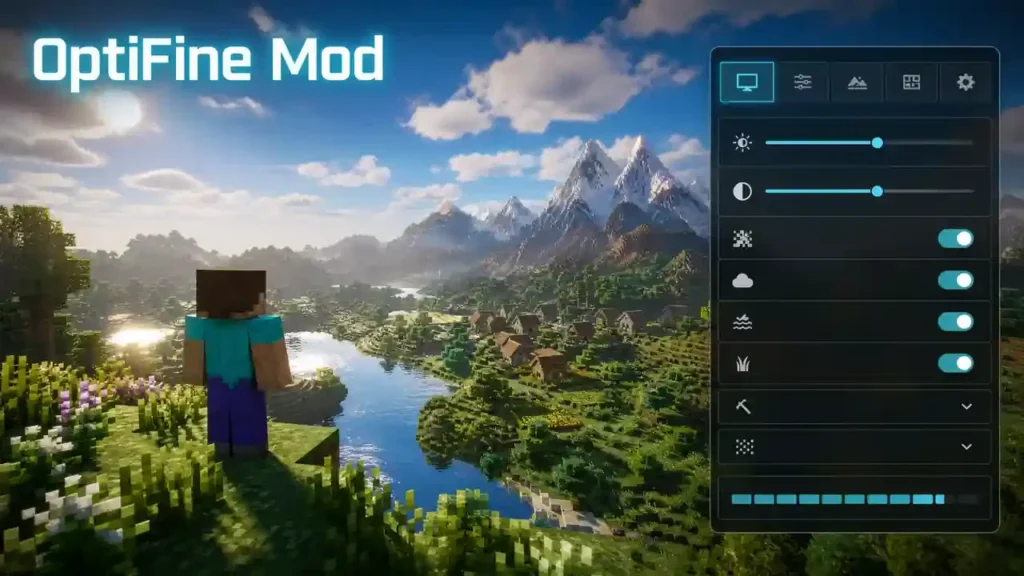
However, compatibility depends on your Minecraft version and other installed mods. Forge can work with supported OptiFine releases, while Fabric requires different considerations. This guide covers the OptiFine mod from download to installation and performance tuning. You will also learn about shaders, resource packs, settings, compatibility, and common problems. You will also see how OptiFine compares with modern alternatives like Sodium and Iris.
What Is the OptiFine Mod?
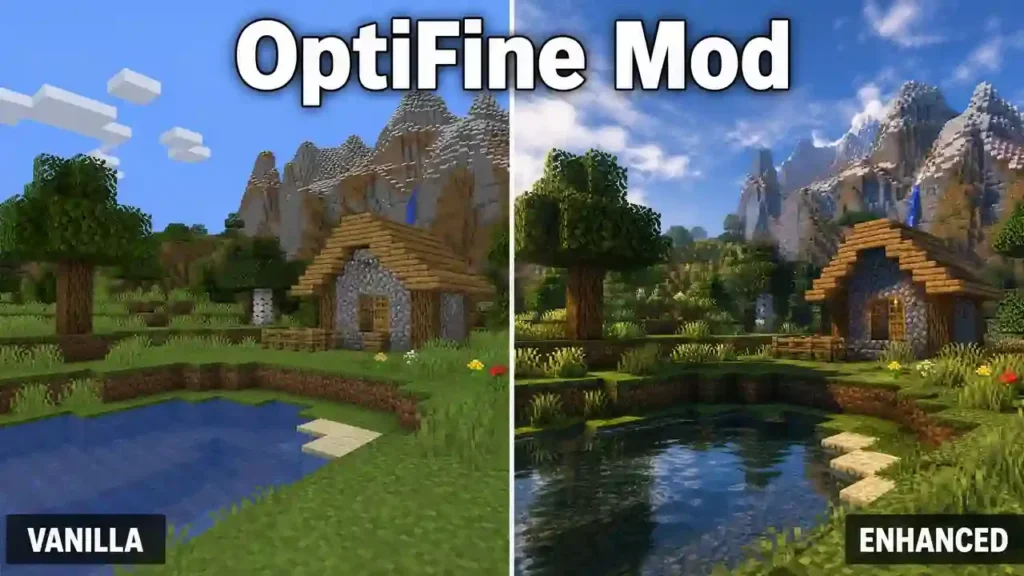
The OptiFine mod is a Minecraft: Java Edition mod for performance and graphics customization. It gives players more control over how Minecraft renders the game. OptiFine adds advanced video settings that vanilla Minecraft does not provide. These settings can help players adjust FPS, render distance, lighting, textures, and visual effects. The mod also supports HD textures, shader packs, dynamic lighting, connected textures, and custom resource-pack features. These features can improve both performance control and visual quality.
OptiFine suits players who want detailed graphics settings in one mod. It also works well for players who use shaders or advanced resource packs. Compatibility varies between Minecraft versions and other mods. Always choose an OptiFine release that matches your Minecraft version.
What Is OptiFine?
OptiFine is a client-side optimization mod for Minecraft: Java Edition. It focuses on performance, graphics, and visual customization.
OptiFine’s Purpose
OptiFine gives players greater control over Minecraft’s rendering system. It can improve FPS and reduce performance issues on supported systems. It also adds many advanced video settings that vanilla Minecraft does not offer. Players can fine-tune graphics based on their hardware and preferred visual quality. These controls make OptiFine useful for both performance-focused and graphics-focused players.
What Is OptiFine HD?
OptiFine HD is the full-featured OptiFine edition. It adds extensive graphics options and resource-pack support. It supports features such as HD textures, shaders, dynamic lighting, and connected textures. It also includes advanced rendering and visual settings.
OptiFine Ultra, Standard, and Light
OptiFine comes in different editions with different feature sets. Ultra provides the most optimizations and features. Standard focuses more on compatibility with other mods. Light targets weaker computers but offers fewer advanced features.
Who Develops OptiFine?
sp614x created and develops OptiFine. The project has supported Minecraft optimization for many years.
Minecraft: Java Edition Compatibility
OptiFine targets Minecraft: Java Edition. Each release matches specific Minecraft versions. Always choose the correct build before installing the mod.
OptiFine Mod Features
The OptiFine mod combines performance tools with extensive graphics controls. Its feature set helps players tune Minecraft for smoother gameplay and better visuals.
FPS Boost and Performance Optimization
OptiFine includes several rendering optimizations that can improve FPS. It can also reduce lag spikes and make gameplay feel smoother. However, FPS gains vary between systems. Your CPU, GPU, resource packs, shaders, and settings all affect performance. Higher-quality options can also reduce FPS.
Shader Support
OptiFine supports shader packs for major visual changes. Shaders can improve lighting, shadows, reflections, water, and other effects. These effects often require more GPU power. A demanding shader can therefore lower FPS.
HD Textures and HD Fonts
OptiFine supports high-resolution textures and fonts without requiring MCPatcher. It also supports custom textures, animated textures, custom colors, and custom lighting.
Dynamic Lighting
Dynamic Lights lets handheld and dropped light sources illuminate nearby objects. This creates a more natural lighting effect during gameplay.
Connected Textures
Connected Textures joins nearby compatible blocks into smoother patterns. Glass, bookshelves, and sandstone can benefit from this feature.
Custom Item Textures
Custom Item Textures (CIT) lets compatible resource packs change item appearances. Resource-pack creators can use this feature for detailed item designs.
Custom Entity Models
Custom Entity Models (CEM) lets compatible resource packs change entity models. This feature can create more detailed or unusual mob appearances.
Random Entities
Random Entities allows resource packs to use different textures for the same mob. This creates more visual variety without changing the entity itself.
Better Grass and Better Snow
Better Grass improves how grass blocks blend with nearby terrain. Better Snow applies similar visual improvements around snow-covered areas.
Natural Textures
Natural Textures reduces repetitive block patterns. It uses rotated and flipped texture variants to create more natural surfaces.
Smooth Lighting
Smooth Lighting creates softer transitions between light levels. OptiFine lets you control its strength from low values to full shadows.
Render Distance
OptiFine provides extensive render-distance control. Its options range from Tiny to Extreme, depending on the version. Higher distances show more terrain but require more system resources. Lower distances can improve performance on weaker hardware.
Mipmaps, Anisotropic Filtering, and Antialiasing
Mipmaps smooth distant textures and make them look less harsh. Anisotropic Filtering restores detail in mipmapped textures at different viewing angles. Antialiasing smooths jagged edges and sharp color transitions. These settings can improve image quality, but they may affect performance.
Fast Render and Smart Leaves
Fast Render provides a faster rendering mode with some visual trade-offs. Smart Leaves can reduce unnecessary detail when rendering leaf blocks. These options can help performance, especially when other settings already push your hardware.
OptiFine Zoom
OptiFine includes a dedicated zoom feature. Players commonly use it to inspect distant builds, terrain, and other details.
VSync and Frame Control
VSync synchronizes Minecraft’s frame rate with your monitor’s refresh rate. It can reduce screen tearing and create smoother motion. OptiFine also includes FPS controls and Smooth FPS options. These tools can help stabilize frame delivery on supported systems. Overall, OptiFine gives players control over both Minecraft performance and visual quality. Its settings let you choose the balance that fits your hardware and playstyle.
OptiFine Mod System Requirements
The OptiFine mod runs with Minecraft: Java Edition on a compatible Minecraft version. Always match the OptiFine release with your installed game version.
Minecraft and Java Requirements
OptiFine depends on the Minecraft version you use. Newer Minecraft releases may also require newer Java versions through the official launcher. Your launcher normally manages the required Java runtime. Check the OptiFine release notes before installing older or newer builds. Version mismatches can cause crashes or installation problems.
CPU and GPU Requirements
OptiFine does not require a high-end computer for basic use. A modern integrated GPU can handle many OptiFine settings. A stronger GPU helps with higher render distances and demanding graphics options. Your CPU also affects chunk loading and overall Minecraft performance.
RAM Requirements
Minecraft’s RAM needs depend on your setup. Basic OptiFine gameplay usually needs less memory than heavily modded Minecraft. Large resource packs and modpacks can increase memory usage. Avoid assigning excessive RAM because more memory does not always improve FPS.
Shader Hardware Requirements
Shaders create much heavier GPU workloads than normal OptiFine gameplay. High-end shader packs can require a dedicated graphics card with strong rendering performance. Shader requirements also vary between packs. Always check the shader creator’s recommended hardware before choosing demanding visual settings.
OptiFine Version Compatibility
OptiFine releases target specific Minecraft: Java Edition versions. Always match the OptiFine build with your Minecraft installation. The official downloads page lists both stable releases and preview builds. Forge support also varies between versions.
| Minecraft Version | OptiFine Version | Forge Support | Status |
| 26.1.2 | K1 pre2 | N/A | Preview |
| 1.21.11 | J9 | Forge 61.0.8 | Listed release |
| 1.21.10 | J7 previews | Forge 60.1.0 | Preview |
| 1.21.8 | J6 previews | Forge 58.1.0 | Preview |
| 1.21.7 | J6 previews | N/A on listed previews | Preview |
| 1.21.6 | J6 previews | N/A on listed previews | Preview |
| 1.21.4 | J4/J3 | Forge 54.1.0 / 54.0.34 | Previous |
| 1.21.1 | J1 | Forge 52.0.16 | Previous |
The official site lists K1 pre2 for Minecraft 26.1.2. It also lists J9 for Minecraft 1.21.11. Minecraft 1.21.1 has the OptiFine HD U J1 release. It lists Forge 52.0.16 compatibility. Preview builds can change as development continues. Their Forge compatibility can also differ from final releases. For the most accurate information, check the official OptiFine downloads page before installing.
Avoid Thin Version Pages
You do not need a separate page for every Minecraft version. That approach can create repetitive content with little value. Instead, maintain one useful compatibility section. Create dedicated version guides only when players need detailed installation or troubleshooting help. This approach supports a stronger topical structure. It also keeps your content useful instead of producing pages only for search traffic.
How to Download the OptiFine Mod Safely
The safest way to download the OptiFine mod is through the official OptiFine website. Its downloads page lists releases by Minecraft version, including current and older builds.
Where to Get OptiFine
Visit the official OptiFine downloads page and find your Minecraft version. Check the listed OptiFine build before downloading.
How to Identify the Correct Version
First, check your Minecraft version in the launcher. Then select the matching OptiFine release. Check the build name, Minecraft version, and release status. OptiFine marks some builds as preview versions. Preview builds can have less testing than final releases.
Download or Mirror?
The official downloads page provides both Download and Mirror options for listed releases. Use the official OptiFine pages rather than random third-party download sites.
Avoid Fake OptiFine Websites
Fake sites often use misleading download buttons or aggressive advertisements. Some may offer modified installers or suspicious executable files. Check the domain before downloading anything. Avoid files from unknown websites or unofficial mirrors. For the best trust and security, verify your Minecraft version and download the matching build from the official OptiFine source.
How to Install the OptiFine Mod
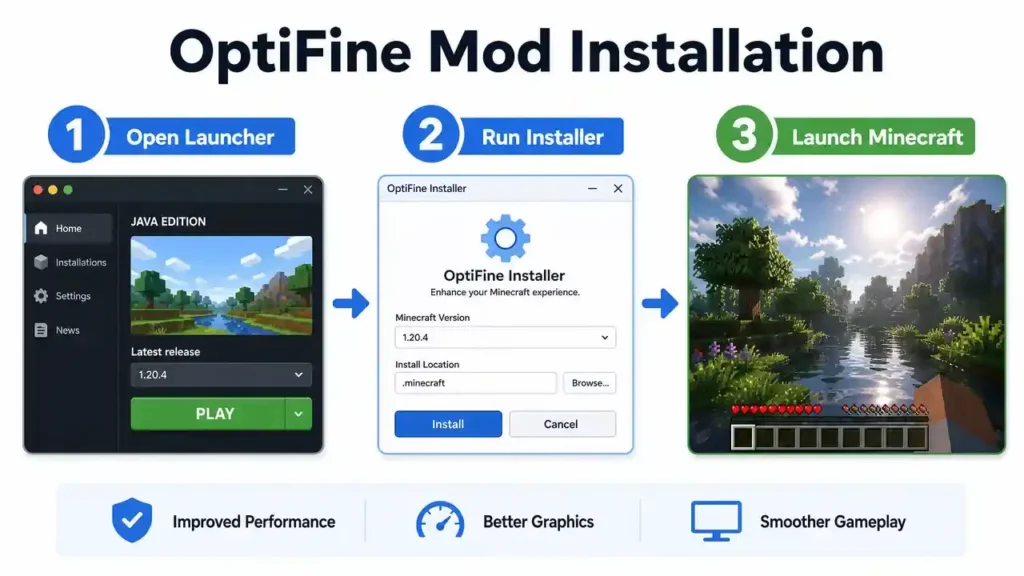
Installing the OptiFine mod usually takes only a few steps. First, make sure your OptiFine build matches your Minecraft version.
Step 1: Check Your Minecraft Version
Open the Minecraft Launcher and check your Minecraft: Java Edition version. Note the exact version number before downloading OptiFine.
Step 2: Download the Matching OptiFine Build
Visit the official OptiFine downloads page. Find the OptiFine release that matches your Minecraft version.
Step 3: Open the OptiFine Installer
Locate the downloaded OptiFine .jar file. Double-click the file to open the installer. If your system cannot open .jar files, check your Java installation. The Minecraft launcher also manages Java for its supported game versions.
Step 4: Select the Minecraft Installation
The installer normally detects your Minecraft directory automatically. Check the displayed folder before continuing.
Step 5: Install OptiFine
Click Install and wait for the installer to finish. OptiFine adds a separate installation to your Minecraft launcher.
Step 6: Open the Minecraft Launcher
Start the official Minecraft Launcher after installation finishes. Open the Java Edition installation list.
Step 7: Select the OptiFine Profile
Choose the OptiFine installation that matches your Minecraft version. Check the version number before launching.
Step 8: Launch Minecraft
Click Play and let Minecraft start. Give the game a moment to load its modified settings.
Verify the Installation
Open Minecraft’s Video Settings after joining a world. OptiFine adds many additional graphics options. You can also check the Minecraft debug screen. Press F3 and look for OptiFine information in the displayed details. If these indicators appear, the OptiFine mod loaded successfully.
OptiFine With Minecraft Forge
Minecraft Forge is a mod loader that lets players run compatible Minecraft mods together. OptiFine can work with Forge when both versions support each other. Players often combine Forge and OptiFine for graphics features alongside other Forge mods. This setup can provide shaders, HD textures, advanced video settings, and broader mod functionality. Version matching matters most. Your Minecraft version, Forge version, and OptiFine build must support the same setup. The official OptiFine downloads page lists Forge compatibility for individual releases.
For example, OptiFine HD U J9 supports Minecraft 1.21.11 and lists Forge 61.0.8. Earlier J8 lists Forge 61.0.7.
| Minecraft | OptiFine | Listed Forge |
| 1.21.11 | J9 | 61.0.8 |
| 1.21.4 | J4 | 54.1.0 |
| 1.21.1 | J1 | 52.0.16 |
| 1.20.1 | I6 | 47.2.18 |
Forge setups can still experience mod conflicts. Other mods may alter rendering systems or depend on different versions. Check the exact OptiFine release before adding it to your Forge installation. The official FAQ also notes that mod conflicts can cause errors and installation problems. For the safest setup, match every component before launching Minecraft.
OptiFine on Fabric
Fabric and OptiFine use different modding ecosystems. Fabric provides its own lightweight mod loader and modding framework for Minecraft Java Edition. OptiFine does not provide official Fabric compatibility. Fabric’s documentation recommends alternatives such as Sodium and Iris instead. OptiFabric is an unofficial compatibility layer. It attempts to help OptiFine run within Fabric installations. However, Fabric’s documentation warns that OptiFabric can create compatibility problems with other mods. This setup can also break when Fabric, OptiFine, or other mods expect different rendering behavior. Fabric’s documentation specifically recommends Iris for shader support in these situations.
For modern Fabric setups, many players choose Sodium + Iris instead. Sodium focuses on rendering performance, while Iris provides shader support. If you still want OptiFine on Fabric, check every component’s Minecraft version first. Also verify compatibility before adding other rendering mods. For the most reliable Fabric setup, use mods designed specifically for the Fabric ecosystem.
Best OptiFine Settings for FPS
The best OptiFine settings for FPS depend on your CPU, GPU, resolution, and resource packs. Start with balanced settings, then adjust one option at a time.
| Setting | Recommended Choice | Performance Effect |
| Render Distance | Medium | High impact |
| Simulation Distance | Moderate | Medium |
| Graphics | Fast | High |
| Smooth Lighting | Low or Off | Medium |
| Clouds | Off | Low–Medium |
| Particles | Decreased | Low |
| Entity Shadows | Off | Low |
| Mipmaps | Moderate | Variable |
| VSync | Off for maximum FPS | Variable |
| Dynamic Lights | Fast or Off | Variable |
Render Distance
Lower render distance reduces the number of chunks Minecraft must process and display. Medium values often provide a good balance between visibility and performance.
Graphics
Choose Fast when FPS matters more than visual quality. This setting reduces several rendering effects.
Smooth Lighting
Lower or disable Smooth Lighting when your system struggles with performance. Higher lighting quality can require additional rendering work.
Clouds and Particles
Turning clouds off removes another visual workload. Decreasing particles can also help during busy scenes.
Entity Shadows
Disable entity shadows if you need extra performance. The visual difference remains small during normal gameplay.
Mipmaps and Dynamic Lights
Moderate mipmap levels provide a useful balance between texture quality and performance. Dynamic Lights can use additional rendering resources, especially during busy scenes.
VSync
Disable VSync when maximum FPS matters most. Keep it enabled if you prefer synchronized frames and reduced screen tearing. OptiFine provides tooltips throughout its Video Settings menu. Use them to understand individual quality and performance trade-offs.
Tip: Change one setting at a time and test the same Minecraft area. This gives you a clearer performance comparison.
OptiFine Shaders Guide
OptiFine shaders change Minecraft’s lighting and visual effects through compatible shader packs. They can create realistic shadows, reflections, water effects, and atmospheric lighting.
What Are OptiFine Shaders?
Shaders are graphics programs that change how Minecraft renders the world. OptiFine provides shader support through its video settings and compatible shader packs. Different packs target different visual styles and hardware levels. Always check a shader pack’s supported Minecraft and OptiFine versions.
How Shaders Affect Minecraft
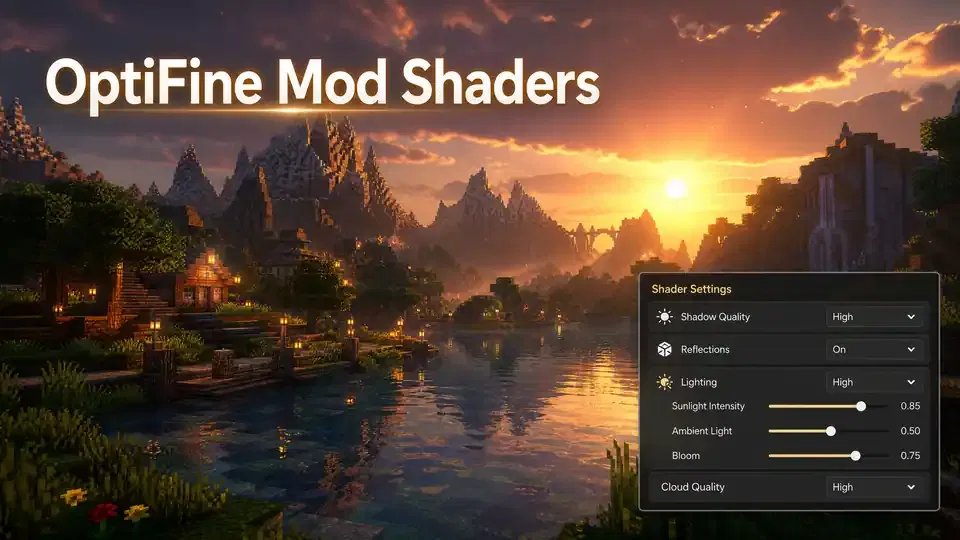
Shaders can transform sunlight, shadows, clouds, water, and reflections. Some packs also add ambient lighting and advanced atmospheric effects. These improvements require additional GPU processing. Therefore, enabling shaders can reduce FPS.
Shader Pack Compatibility
Not every shader pack works with every OptiFine release. Compatibility can depend on Minecraft, OptiFine, the shader pack, and other installed mods. Check the shader creator’s documentation before installation. Use a version that matches your Minecraft setup.
Settings for Low-End PCs
Start with lightweight shader packs and lower their quality settings. Reduce shadow resolution, render quality, reflections, and other demanding effects. Lowering Minecraft’s render distance can also reduce the overall workload.
Settings for High-End PCs
Stronger systems can handle higher shader quality. Increase shadow resolution, reflections, volumetric effects, and render quality gradually. Monitor FPS after each change.
Why Shaders Reduce FPS
Shaders add extra calculations for lighting, shadows, reflections, and other effects. Your GPU handles much of this additional workload.
Troubleshooting Shader Crashes
First, disable the shader and launch Minecraft again. Then check your OptiFine version and shader compatibility. Remove conflicting visual mods and test the shader with a clean setup. If problems continue, check the shader creator’s support information. Always match the shader pack with your specific Minecraft and OptiFine versions.
OptiFine Resource Pack Support
The OptiFine mod adds extensive resource pack support beyond Minecraft’s standard texture options. These features let resource pack creators build more detailed and varied visuals.
HD Textures
OptiFine supports high-resolution textures for sharper blocks, items, and environments. This support helps resource packs deliver detailed visuals.
Custom Item Textures
Custom Item Textures (CIT) lets resource packs change item appearances. Creators can design different textures for specific items and conditions.
Connected Textures
Connected Textures (CTM) joins compatible block textures together. Glass and other blocks can appear smoother without obvious texture borders.
Custom Entity Models
Custom Entity Models (CEM) lets supported resource packs change entity models. This feature can give mobs more detailed shapes and designs.
Random Entities
Random Entities adds visual variety by assigning different textures to similar entities. This can make repeated mobs look less identical.
Animated Textures
Resource packs can use animated textures for moving visual elements. These effects can add life to blocks, items, and other game elements.
Custom Fonts
OptiFine supports custom fonts through compatible resource packs. Creators can replace Minecraft’s default text appearance.
Custom Colors
Custom Colors lets compatible resource packs change specific visual colors. These changes can affect elements such as foliage, lighting, and other supported textures. Together, these features make OptiFine resource packs highly customizable. Always check the resource pack’s requirements before installation, because feature support can vary between packs and Minecraft versions.
OptiFine vs Sodium
OptiFine and Sodium both target Minecraft performance, but they follow different approaches. OptiFine combines optimization with many graphics and resource-pack features. Sodium focuses mainly on improving Minecraft’s rendering performance and reducing micro-stutter.
| Feature | OptiFine | Sodium |
| FPS optimization | Yes | Yes |
| Shader support | Built-in | Usually paired with Iris |
| HD resource-pack features | Extensive | Uses separate mods |
| Zoom | Built-in | Separate mod |
| Dynamic lighting | Built-in | Separate mod |
| Mod ecosystem | Traditional | Modern Fabric ecosystem |
| Configuration | Extensive | More modular |
OptiFine provides shaders, HD textures, connected textures, dynamic lighting, zoom, and many video controls in one mod. Sodium takes a more focused approach to rendering performance. It supports modern Fabric and NeoForge setups on current Minecraft versions. For shaders, Sodium commonly works with Iris. Other visual features can come from separate mods. Neither option suits every player. OptiFine fits players who want many built-in visual features. Sodium suits players who prefer a modular modern mod setup. Your Minecraft version and mod requirements should guide the final choice.
OptiFine vs Iris
OptiFine and Iris serve different roles in Minecraft’s modding ecosystem. OptiFine combines performance optimization with many graphics and resource-pack features. Iris Shaders focuses mainly on shader support. It provides a modern shader loader for compatible Minecraft installations. Iris commonly works alongside Sodium, which handles rendering optimization.
| Feature | OptiFine | Iris |
| Performance optimization | Built-in | Usually paired with Sodium |
| Shader support | Built-in | Core feature |
| HD resource-pack features | Extensive | Uses separate mods |
| Dynamic lighting | Built-in | Separate mod |
| Zoom | Built-in | Separate mod |
| Mod ecosystem | OptiFine-based | Modern Fabric ecosystem |
OptiFine suits players who want many features inside one mod. Its settings cover performance, shaders, textures, lighting, and visual customization. Iris suits players who prefer a modular Fabric setup. You can combine Iris with Sodium and other specialized mods. For example, Continuity can provide connected textures. LambDynamicLights can add dynamic lighting. Choose OptiFine for its integrated feature set. Choose Iris with Sodium when you prefer a modern, modular setup. Neither option works best for every Minecraft setup.
Best OptiFine Alternatives
Modern Minecraft offers several OptiFine alternatives for performance, shaders, and visual features. These mods often follow a modular approach instead of combining everything into one package.
Performance Alternatives
Sodium focuses on rendering performance and works within modern modding ecosystems. Embeddium provides a similar performance-focused approach for Forge and NeoForge setups. Lithium improves Minecraft’s game logic and server-side calculations. FerriteCore reduces memory usage in supported setups. ImmediatelyFast improves the performance of several immediate-mode rendering tasks. Entity Culling skips rendering entities that players cannot see.
Shader Alternatives
Iris provides shader support for modern Minecraft setups. It commonly works with Sodium for both performance and shader support. Oculus provides shader support for compatible Forge and NeoForge environments.
Visual Feature Alternatives
Continuity adds connected texture support. Entity Model Features (EMF) provides custom entity model support for compatible resource packs. LambDynamicLights adds dynamic lighting functionality to supported modded setups.
Modpack Alternatives
Fabulously Optimized combines multiple optimization and visual mods into a ready-to-use package. Additive follows a similar multi-mod approach for performance and visual improvements. These alternatives differ from OptiFine’s all-in-one design. Instead, players can select individual mods for specific needs. That modular approach can improve flexibility and compatibility. However, it also requires more planning because several mods may replace OptiFine’s different features.
Common OptiFine Problems and Fixes
Even a correct OptiFine mod installation can cause problems with incompatible versions or settings. Start troubleshooting by checking your Minecraft version and OptiFine build.
OptiFine Does Not Appear in Minecraft
Check that your OptiFine version matches Minecraft. Then confirm that the installer completed successfully. Open the Minecraft Launcher and check the installation list. Select the correct OptiFine profile before launching the game.
Minecraft Crashes After Installation
Mod conflicts can cause crashes when OptiFine runs with other modifications. An incompatible Forge version can create similar problems. Shaders and resource packs can also cause crashes. Disable them temporarily and test Minecraft again. If Minecraft works afterward, enable each modification separately to identify the conflict.
Shaders Are Not Working
First, confirm that your shader pack supports your Minecraft and OptiFine versions. Then check your graphics drivers and shader settings. Try another compatible shader pack if the problem continues. This test can help determine whether the shader itself causes the issue.
FPS Became Worse
OptiFine does not guarantee higher FPS in every setup. Excessive render distance, shaders, high-resolution resource packs, and demanding visual settings can reduce performance. Lower these settings gradually and test the same area after each change.
Chunks Flicker
Chunk flickering can result from certain chunk-loading settings or graphics-driver issues. OptiFine’s official FAQ recommends changing chunk-loading options and checking graphics-driver compatibility. For persistent problems, return settings to their defaults. Then change one option at a time.
Tip: Always test OptiFine with a clean setup first. Add Forge mods, shaders, and resource packs afterward. This makes conflicts much easier to identify.
Is OptiFine Safe?
The OptiFine mod is safest when you download it from the official OptiFine website. The official downloads page provides releases for specific Minecraft versions. Always match the OptiFine build with your Minecraft version. Avoid modified installers from unknown websites because you cannot verify their contents. Be careful with suspicious mirrors and misleading download buttons. Some websites may use advertisements that look like download links.
Before opening an unexpected .jar file, verify its source and filename. You can also scan unfamiliar files with your security software. Keep regular backups of important Minecraft worlds. This protects your saves if an installation causes unexpected problems. OptiFine’s official website should remain your primary download source. Do not assume every third-party OptiFine download has the same level of trust. For the safest setup, verify the source, match the version, and avoid unofficial modified files.
Who Should Use OptiFine?
OptiFine suits Minecraft players who want performance controls and visual features in one mod. It works especially well for players who prefer simple configuration.
Use OptiFine If You Want
- Built-in shader support.
- Extensive video and performance settings.
- HD resource-pack features.
- Dynamic lighting.
- Connected textures and custom visual features.
- Built-in zoom controls.
- An all-in-one optimization and graphics solution.
OptiFine also suits players who enjoy customizing Minecraft without installing many separate feature mods.
Consider Alternatives If You Want
Modern Fabric optimization may suit players who prefer a modular setup. Sodium focuses on rendering performance, while Iris provides shader support. A modular setup can also suit large modern modpacks. You can select separate mods for performance, lighting, textures, and entity rendering. Players who already use Sodium and Iris may prefer staying within that ecosystem. This approach can provide broader access to modern Fabric optimization mods. Your Minecraft version and existing mods should guide the final decision. Neither approach fits every player or every modded setup.
Pros and Cons of OptiFine
The OptiFine mod remains popular because it combines performance tools with many visual features. However, it also has limitations that players should consider.
Pros
- Performance optimization: OptiFine provides many settings for improving rendering performance.
- Extensive configuration: Players can fine-tune many Minecraft graphics options.
- Shader support: Compatible shader packs can add advanced lighting and visual effects.
- HD textures: OptiFine supports high-resolution resource packs.
- Dynamic lighting: Light sources can create more flexible lighting effects.
- Resource-pack features: CIT, CEM, connected textures, and other features expand customization.
- Zoom: The built-in zoom feature provides quick access to distant details.
- Long development history: OptiFine has supported Minecraft optimization for many years.
Cons
- Version compatibility varies: Each OptiFine build targets specific Minecraft versions.
- Unofficial Fabric integration: OptiFabric does not provide official Fabric support.
- Modpack compatibility: Some modern modpacks prefer Sodium-based optimization stacks.
- Shader performance: Demanding shaders can significantly reduce FPS.
Overall, OptiFine offers broad features, but modern alternatives may better suit some modded setups.
Frequently Asked Questions
What is the OptiFine mod?
The OptiFine mod is a Minecraft: Java Edition optimization and graphics mod. It adds performance controls and advanced visual features.
Is OptiFine free?
Yes. OptiFine provides free downloads through its official website. Always use the official source for downloads.
Does OptiFine increase FPS?
OptiFine can improve FPS on some systems. Results depend on hardware, Minecraft settings, resource packs, shaders, and other mods.
Is OptiFine safe?
OptiFine is safest when downloaded from its official website. Avoid modified installers and suspicious third-party downloads.
Is OptiFine still supported?
Yes. The official website continues to list OptiFine releases for supported Minecraft versions. Check the official downloads page for current builds.
Does OptiFine work with Minecraft 1.21?
Yes, OptiFine has releases for several Minecraft 1.21 versions. You must match the OptiFine build with your exact Minecraft version.
Does OptiFine work with Minecraft 26.1.2?
The official downloads page lists OptiFine HD U K1 pre2 for Minecraft 26.1.2. It currently appears as a preview release.
Can I use OptiFine with Forge?
Yes, compatible OptiFine builds can work with Forge. Always check the Forge version listed for your specific OptiFine release.
Can I use OptiFine with Fabric?
OptiFine does not provide official Fabric support. OptiFabric offers unofficial compatibility, while Sodium and Iris provide modern alternatives.
Does OptiFine support shaders?
Yes. OptiFine supports compatible shader packs. However, shader compatibility varies between Minecraft versions, OptiFine builds, and shader packs.
Does OptiFine support HD textures?
Yes. OptiFine supports HD textures and several advanced resource-pack features.
Is OptiFine better than Sodium?
Neither is universally better. OptiFine provides many built-in features, while Sodium focuses strongly on rendering performance.
Is OptiFine better than Iris?
They serve different purposes. OptiFine combines optimization and graphics features, while Iris focuses mainly on shader support.
What is the best OptiFine setting for FPS?
Lower Render Distance, use Fast Graphics, and reduce demanding visual effects. Your ideal settings depend on your hardware.
Why does OptiFine crash Minecraft?
Version mismatches, mod conflicts, shader problems, and resource packs can cause crashes. Test OptiFine without additional modifications first.
Can OptiFine work with other mods?
Yes, but compatibility varies. Check your OptiFine version, Minecraft version, Forge version, and other installed mods before combining them.
Conclusion
The OptiFine mod remains a powerful choice for Minecraft: Java Edition players. It combines performance controls with extensive graphics customization. Its biggest strengths include FPS optimization, shader support, HD textures, dynamic lighting, resource-pack features, and detailed video settings. OptiFine suits players who want many features inside one familiar mod. It also works well for players who enjoy shaders and customized resource packs. Version compatibility remains important. Always match your OptiFine build with your Minecraft version and other installed mods.
Modern alternatives can make more sense for players using Fabric-based modpacks. Sodium, Iris, and other specialized mods offer a modular approach. Choose the setup that matches your hardware, Minecraft version, and preferred features. This approach gives you better performance without sacrificing the visual experience you want.